
Between 2.3 and 3.3 million years ago, atmospheric CO2 levels were similar to what they are now, and the Earth was about 2ºC warmer than it is today, a team of scientists reported, showing that carbon dioxide levels are linked to temperature.
The study, led by researchers at the University of Southampton in England, said their findings support the recent climate change assessment from the IPCC (Intergovernmental Panel on Climate Change).
By studying the relationship between climate change and carbon dioxide levels during the Pliocene, which was a warmer period in this planet’s history, the research team has been able to estimate how climate is likely to respond to rising levels of CO2, a parameter they refer to as “climate sensitivity”.
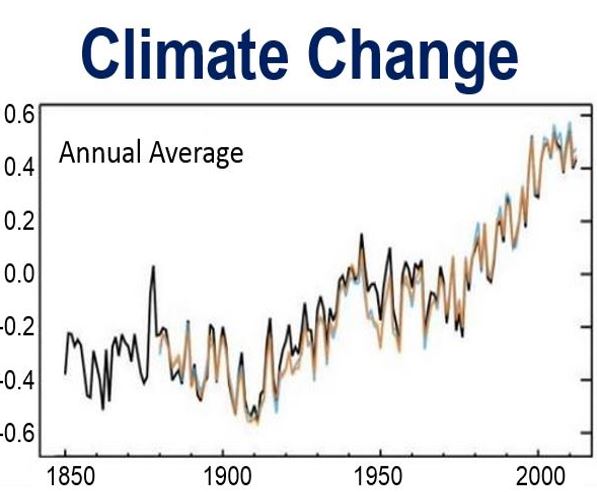
Global averaged combined land and ocean surface temperatures (Celcius). The IPCC believes humans are changing the climate. (Image: IPCC)
Their findings have been published in the academic journal Nature (citation below). They show how climate sensitivity can change over the long term.
Study co-author, Dr. Gavin Foster, Associate Professor in Isotope Geochemistry at the Ocean and Earth Science, National Oceanography Centre Southampton, University of Southampton, said:
“Today the Earth is still adjusting to the recent rapid rise of CO2 caused by human activities, whereas the longer-term Pliocene records document the full response of CO2-related warming.”
“Our estimates of climate sensitivity lie well within the range of 1.5 to 4.5ºC increase per CO2 doubling summarised in the latest IPCC report. This suggests that the research community has a sound understanding of what the climate will be like as we move toward a Pliocene-like warmer future caused by human greenhouse gas emissions.”
Lead author, Dr Miguel Martínez-Botí, also from the University of Southampton said:
“Our new records also reveal an important change at around 2.8 million years ago, when levels rapidly dropped to values of about 280 ppm, similar to those seen before the industrial revolution. This caused a dramatic global cooling that initiated the ice-age cycles that have dominated Earth’s climate ever since.”
Climate change sensitivity during cold vs. warm periods
The scientists also set out to determine whether climate change sensitivity might be different during warmer periods, like the Pliocene, compared to colder times, like the glacial cycles of the past 800,000 years.
Professor Eelco Rohling, who works at the College of Physical and Mathematical Sciences, at The Australian National University in Canberra, said:
“We find that climate change in response to CO2 change in the warmer period was around half that of the colder period. We determine that this difference is driven by the growth and retreat of large continental ice sheets that are present in the cold ice-age climates; these ice sheets reflect a lot of sunlight and their growth consequently amplifies the impact of CO2 changes.”
Professor Richard Pancost, from the University of Bristol Cabot Institute in England, added:
“When we account for the influence of the ice sheets, we confirm that the Earth’s climate changed with a similar sensitivity to overall forcing during both warmer and colder climates.”
IPCC Fifth Assessment Report
According to the IPCC, evidence of the human influence on the climate system is compelling and growing, with impacts observed on every continent.
If we continue unchecked, climate change will increase the probability of severe, pervasive and irreversible impacts for people and ecosystems.
On a hopeful note, the IPCC adds:
“However, options are available to adapt to climate change and implementing stringent mitigations activities can ensure that the impacts of climate change remain within a manageable range, creating a brighter and more sustainable future.”
Citation: “Plio-Pleistocene climate sensitivity evaluated using high-resolution CO2 records,” M. A. Martínez-Botí, G. L. Foster, T. B. Chalk, E. J. Rohling, P. F. Sexton, D. J. Lunt, R. D. Pancost, M. P. S. Badger & D. N. Schmidt. Nature, 518, 49–54 (05 February 2015) doi:10.1038/nature14145.
