
Magnetoception, the ability to sense magnetic fields, is something birds, insects, turtles, sharks, stingrays and bacteria have to perceive direction, altitude or location, but not humans … until now, that is. Scientists have created an ultra-thin sensor which can give us this “sixth sense”.
German and Japanese scientists have developed an ultra-thin magnetic sensor, which they say is robust and pliable enough to be easily adapted to human skin. It can even be placed on the most flexible part of the human palm.
The researchers said it “feeds the vision to equip humans with magnetic sense.”
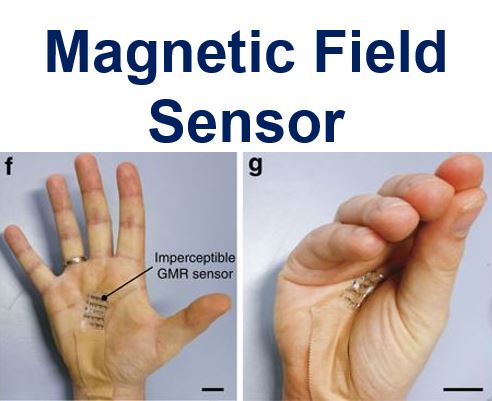
Imperceptible magnetic field sensor on a human palm. Scale bars, 20 mm. (Image: Nature Communications)
Many creatures use magnetoception to detect magnetic fields for navigation and orientation. We are unable to perceive magnetic fields naturally.
Team leader, Dr. Denys Makarov, and colleagues developed an electronic-skin device with a magneto-sensory system. It equips the user with a “sixth sense”, giving him or her the ability to perceive static or dynamic magnetic fields.
Ultra thin, flexible and super light
The device is less than two micrometers thick and weighs just three grams per square meter. You can place it on a soap bubble and it will still float in the air. (1 micrometer, or micron, is one-millionth of a meter or one thousandth of a millimeter).
Sensor-performance is not undermined if the magnetic sensor is crumpled like a piece of paper. It can withstand extreme bending with radii of less one three micrometers.
It can be stretched on elastic supports to over 270% of its original size for more than 1,000 cycles without fatigue. “These versatile features are imparted to the magnetoelectronic elements by their ultra-thin and –flexible, yet robust polymeric support,” the scientists say.
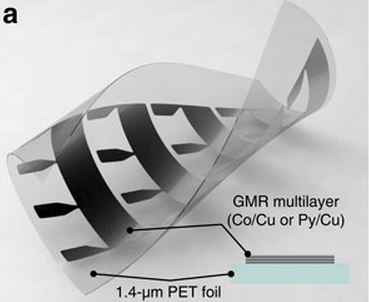
Diagram of an imperceptible magnetic sensor foil. Cross-section of the GMR layer system (inset). (Image: Nature Communications)
Team member, Ph.D. student Michael Melzer, said:
“We have demonstrated an on-skin touch-less human-machine interaction platform, motion and displacement sensorics applicable for soft robots or functional medical implants as well as magnetic functionalities for electronics on the skin.”
Professor Oliver G. Schmidt, director of the Institute for Integrative Nanosciences at the IFW Dresden, Germany, said:
“These ultrathin magnetic sensors with extraordinary mechanical robustness are ideally suited to be wearable, yet unobtrusive and imperceptible for orientation and manipulation aids.”
The sensor was created at the Leibniz Institute for Solid State and Materials Research (IFW Dresden) and the TU Chemnitz. Scientists at Osaka University and the University of Tokyo also collaborated.
Citation: “Imperceptible magnetoelectronics,” Michael Melzer, Martin Kaltenbrunner, Denys Makarov, Dmitriy Karnaushenko, Daniil Karnaushenko, Tsuyoshi Sekitani, Takao Someya & Oliver G. Schmidt. Nature Communications 6, Article number: 6080. DOI:10.1038/ncomms7080.
