

The wealthiest one percent of people in the world own almost half of all its assets, says the Global Wealth Report 2014, published by the Credit Suisse Research Institute. The world’s poorest 50% of people own less than 1% of total global wealth.
Since 2008, wealth inequality has widened across the globe, especially in China, India and most other emerging economies.
The number of UHNW (ultra-high net worth) individuals has increased sharply over the last year. A UHNW person has a net worth of $50 million or more.
According to the authors, there are 128,000 UHNW individuals globally. Forty-nine percent of them are in the United States (62,900), which saw an increase of 9,600 compared to one year ago. China, in second place, has 7,600 UHNW individuals.
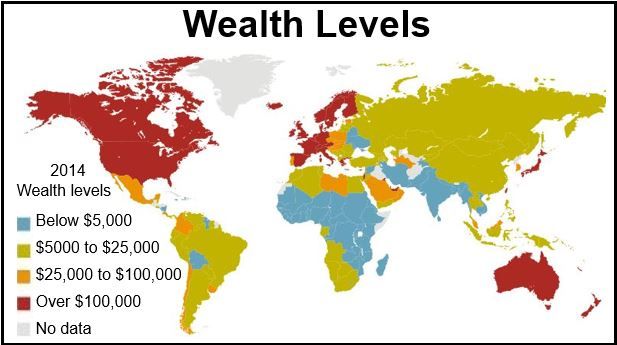
(Source: Global Wealth Report 2014)
Wealth gap widening
Growth in the number of millionaires and billionaires is occurring at a faster pace than average wealth. The widening wealth gap both globally and within virtually every country has today become a popular topic among lawmakers, economists and the media.
While narrowing slightly in many parts of the world before the global financial crisis, inequality has accelerated since 2008.
According to the Report, world wealth over the past 12 months has risen by $20.1 trillion, reaching a total of $263 trillion.
Wealth creation has been particularly strong in the US, “where financial crisis losses were trumped in a single year,” the authors wrote.
Despite a challenging environment across the world this year, the Report informs that total wealth increased to a record high over the past twelve months. It increased by 8.3%.
Wealth creation grew by 11.4% in North America to $91 trillion, where it now represents 34.7% of global wealth. European wealth increased by 10.6% to $85.2 trillion, placing the region in second place (after North America).
The key sources of wealth growth in both continents were capital markets. In the US, equity market capitalization increased by 22.6%, and by 30% in Germany, France and Canada.
