
Climate change is having an ever-increasing effect on wine grape harvest timing, and diminishing the historically important link between droughts and harvest dates in Switzerland and France, say scientists from Harvard University and NASA. The change over time seen in France and Switzerland most likely has also occurred in other wine-producing countries.
In this latest study, researchers carefully analyzed wine grape harvest dates over a four-hundred-year period – from 1600 to 2007.
Ben Cook, climate scientist at NASA’s Goddard Institute for Space Studies and the Lamont Doherty Earth Observatory at Columbia University in New York, and a colleague from Harvard University wrote in the prestigious journal Nature Climate Change (citation below) that harvests started shifting dramatically earlier during the second half of the 20th century.
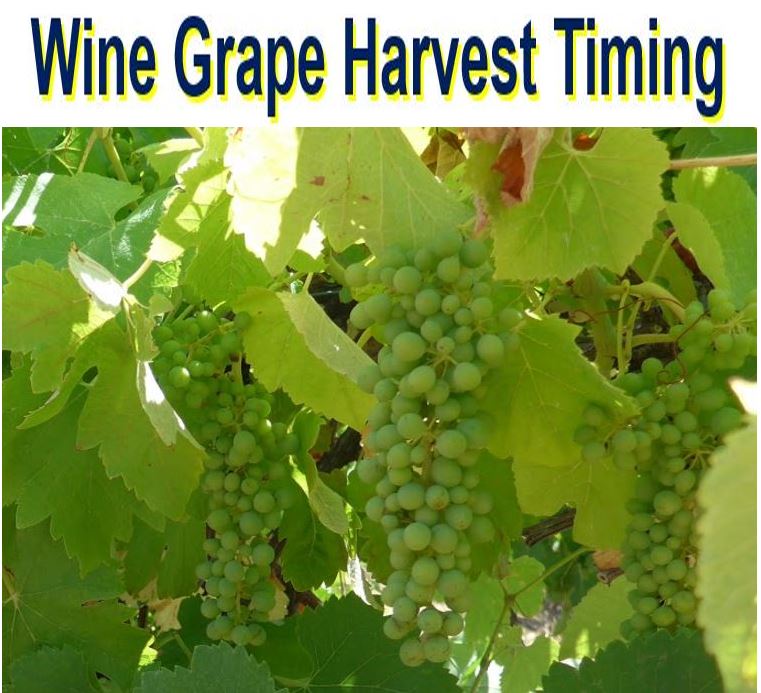 Because of their long-term record, grapes have allowed us to see that we have fundamentally shifted the climate system through our actions, says Prof. Wolkovich. (Image: nasa.gov)
Climate change became main driver of harvest timing
These shifts were due to changes in the connection between climate and harvest timing. While earlier harvests from 1600 to 1980 happened in years with an abnormally warm and dry spring and summer, from 1981 onward warming attributed to climate change resulted in earlier harvests regardless of spring/summer temperatures or amounts of rainfall.
In other words, climate change has taken over the timing of wine grape harvests since 1980 – dry and warm springs and summers are not the main deciding factors any more.
Dr. Cook, who was also lead author, said:
“Wine grapes are one of the world’s most valuable horticultural crops and there is increasing evidence that climate change has caused earlier harvest days in this region in recent decades. Our research suggests that the climate drivers of these early harvests have changed.”
Historically, the best wines have come from grapes harvested when summers have been warm, rainfall has been above average early in the growing season, followed by a late-season drought.
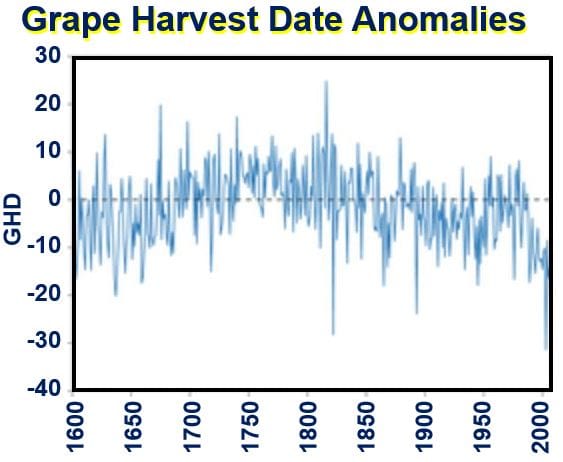 Time series of grape harvest date anomalies, composited from the Alsace, Bordeaux, Burgundy, Champagne 1, Languedoc (Lan), Lower Loire Valley (LLV), Southern Rhone Valley, and Switzerland at Lake Geneva. (Image: Nature Climate Change)
Co-author, ecologist Elizabeth Wolkovich of Arnold Arboretum and the Department of Organismic and Evolutionary Biology at Harvard University, said:
“This gives vines plenty of heat and moisture to grow early in the season, while drier conditions later in the season shift them away from vegetative growth and toward greater fruit production.”
The scientists gathered and analyzed data on four hundred years of harvests from Western Europe. They considered variability and trends in harvest dates, climate data from instruments over the past 100 years, and reconstructions from historical documents and tree rings of temperature, rainfall and soil moisture dating back to 1600.
That analysis was compared with shifts in the quality of wine in the Burgundy and Bordeaux regions of France based on vintage ratings during the last 100 years.
Detailed information regarding quality was available for those two regions, as well as broader harvest data across most of France and Switzerland.
Droughts no longer determine when harvests occur
The results suggest there has been a fundamental shift in the role of drought and moisture as large-scale drivers of wine quality and harvest time.
While higher temperatures have consistently resulted in earlier harvests and better-quality wines, in recent decades the impact of drought has largely vanished as a result of large-scale shifts in climate.
Dr. Cook said:
“Wine quality also depends on a number of factors beyond climate, including grape varieties, soils, vineyard management and winemaker practices. However, our research suggests the large-scale climate drivers these local factors operate under has shifted.”
“And that information may prove critical to wine producers as climate change intensifies during the coming decades in France, Switzerland and other wine-growing regions.”
In an Abstract in the journal, the authors concluded:
“The relationship between drought and temperature in this region, however, has weakened in recent decades and enhanced warming from anthropogenic greenhouse gases can generate the high temperatures needed for early harvests without drought.”
“Our results suggest that climate change has fundamentally altered the climatic drivers of early wine grape harvests in France, with possible ramifications for viticulture management and wine quality.”
Prof. Wolkovich said:
“There are two big points in this paper. The first is that harvest dates are getting much earlier, and all the evidence points to it being linked to climate change. Especially since 1980, when we see a major turning point for temperatures in the Northern Hemisphere, we see harvest dates across France getting earlier and earlier.”
“The bad news is that if we keep warming the globe, we will reach a tipping point. The trend, in general, is that earlier harvests lead to higher-quality wine, but you can connect the dots here … We have several data points that tell us there is a threshold we will probably cross in the future where higher temperatures will not produce higher quality.”
Citation: “Climate change decouples drought from early wine grape harvests in France,” Benjamin I. Cook & Elizabeth M. Wolkovich. Nature Climate Change. 21 March 2016. DOI: 10.1038/nclimate2960.
Video – Climate change means better French wine
Climate change means higher temperatures, which for French vineyards means better wines – at least for now. Who knows what will happen when we reach tipping point.
