
Too many young bees are being forced to grow up too fast and start foraging when they are too young, a phenomenon that is behind the decline in the world’s bee population, say researchers from Queen Mary University in London, The University of Sydney, Macquarie University in Sydney, and Washington University in St. Louis.
Their study findings have been published in the peer-reviewed academic journal Proceedings of the National Academy of Sciences (citation below).
Colony Collapse Disorder (CCD), which the US Department of Agriculture describes as a “syndrome defined as a dead colony with no adult bees or dead bee bodies but with a live queen and usually honey and immature bees still present,” is a serious threat to bee colonies globally and affects their ability to perform crucial human food crop pollination.
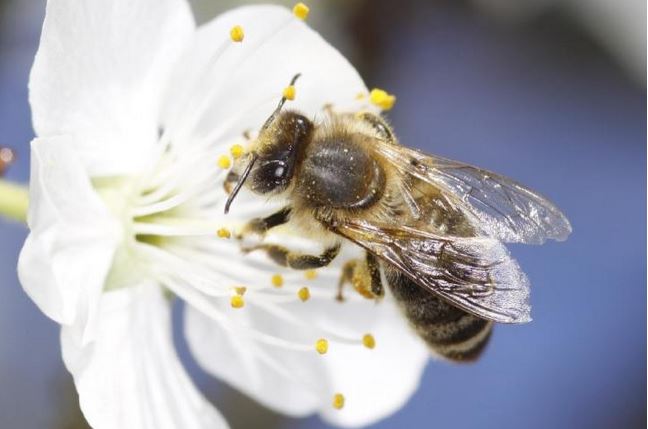
A bee collecting pollen from a flower. (Credit: QMUL. Photo: Eurekalert)
Scientists and farmers worldwide have become increasingly concerned about CCD for at least ten years. So far, no specific cause for the phenomenon has been clearly identified.
Stress makes younger bees start foraging too early
A bee usually starts foraging when it is two to three weeks old. However, when bee colonies are stressed by lack of food, disease or other factors that kill off the adult bees, the younger ones start foraging at a younger age.
In this study, the scientists attached radio trackers to thousands of bees and monitored their movements throughout their lives.
They noticed that the insects that began foraging at a younger age were more likely to die on their first flights, while those that continued completed fewer foraging flights compared to the others.
Dr Clint Perry, from the School of Biological and Chemical Sciences at QMUL, and colleagues used this data to model the impact on honey bee colonies.
They found that any stress that led to chronic forager death of the normally older bees eventually resulted in an increasingly younger foraging force.
Younger foraging speeds up colony decline
The younger foraging population performed more poorly and died in larger numbers, which considerably accelerated the colony’s decline, much like the CCD observations witnessed globally.
Dr. Perry said:
“Young bees leaving the hive early is likely to be an adaptive behaviour to a reduction in the number of older foraging bees. But if the increased death rate continues for too long or the hive isn’t big enough to withstand it in the short term, this natural response could upset the societal balance of the colony and have catastrophic consequences.”
“Our results suggest that tracking when bees begin to forage may be a good indicator of the overall health of a hive. Our work sheds light on the reasons behind colony collapse and could help in the search for ways of preventing colony collapse.”
According to a Yale e360 article, one in every three bites of food eaten globally depends on pollinators, especially bees, for a successful harvest. Several countries, especially in Europe and North America, are alarmed that the rapidly-declining bee populations may threaten food security.
Citation: “Rapid behavioral maturation accelerates failure of stressed honey bee colonies,” Clint J. Perry, Eirik Søvik, Mary R. Myerscough, and Andrew B. Barron. Proceedings of the National Academy of Sciences. February 9, 2015. DOI: 10.1073/pnas.1422089112.
