
Official figures reveal that 2.9 percent of workers in the UK now have zero hours contracts for their main job. This compares with 2.4 percent for the same time last year.
The latest estimates from the Office for National Statistics (ONS) show that 903,000 of the employed UK workforce say their main job is on a zero hours contract. This is 20 percent more than for the same period last year.
 Official figures show over 900,000 UK workers are on zero hours contracts for their main job.
“Zero hours contract” is not a legal term, but is generally regarded as a casual job with no guaranteed hours.
It allow employers to hire workers only when they need them, and pay them only for the hours they work – there are no minimum set hours. Also, workers have the right to turn down work that is offered to them.
Employers in sectors where demand for labour can fluctuate unpredictably often use zero hours contracts.
The ONS figures show the accommodation and food industry sector is the biggest employer of workers on zero hours – one in four such workers in the UK have jobs in that sector, where 13 percent of employees are on zero hours.
Flexibility versus insecurity
Some are in favour of zero hour contracts because they give workers flexibility, while others, like the Trades Union Congress (TUC), say they give employers a way to hire staff on the cheap and avoid worker’s rights.
TUC General Secretary Frances O’Grady says talk about the “flexibility” that zero hours contracts offer overlooks the insecure nature of such jobs. She notes:
“If you don’t know how much work you will have from one day to the next, paying the bills and arranging things like childcare can be a nightmare.”
A new TUC analysis shows that the typical UK employee earns 50 percent more an hour than typical workers on zero hours.
There have been calls for increased protection, and pressure from some quarters to ban zero hours contracts altogether, as many claim New Zealand have done (actually, if you look at the detail of the legislation, it does not look so much as an outright ban as a tightening of the noose – see this interesting blog about it).
In May 2015, the UK government banned exclusivity terms from zero hours contracts so employers are not allowed to prevent workers on such contracts from working for another employer.
Conor D’Arcy, Policy Analyst at the Resolution Foundation, says:
“For some, zero hours contracts are symbolic of Britain’s job-creating labour market flexibility, while for others they represent the deep insecurity that belies the recent jobs recovery.”
He says the fact that more and more of the UK workforce is now working under these conditions, and that the Prime Minister referred to job insecurity as a key issue in her maiden speech, means the government needs to take a close look at zero hours contracts.
The Resolution Foundation do not recommend banning them altogether because there are many workers – such as students and people with caring responsibilities – who really value the flexibility they offer.
‘No more or less happy’ but want more hours
A 2015 survey from the CIPD, the professional body for HR and people development, found that on average, people on zero hours contracts were no more or less happy than people with regular jobs.
Workers on zero hours contracts “experience similar levels of job satisfaction, work-life balance, and personal well-being to employees on permanent, full-time contracts,” they found.
However, the CIPD say they also found that while the majority of workers on zero hours choose to work part-time, they are more likely than part-time employees as a whole to say they would prefer to work more hours.
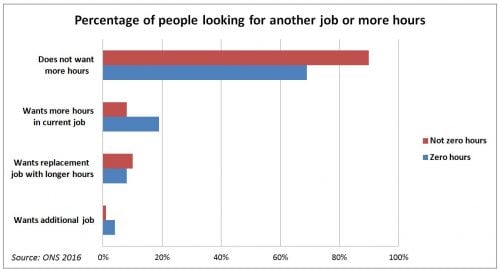 Many workers on zero hours contracts say they would like to work more hours
The ONS note that their figures may differ from other estimates because they calculate the number of individuals on zero hours contracts and not the number of such contracts that businesses use. A worker may have two or more jobs with different employers on zero hours terms.
The ONS figures also show that the average zero hours person works 25 hours a week and is more likely to be:
– female (55 percent of zero hours workers are women – this compares with 45 percent of women who say they are not on zero hours)
– young (36 percent of zero hours workers are aged 16-24, compared with 12 percent of all employees)
– in full-time education (20 percent compared with 2 percent of all employees).
Workers on zero hours contracts are also more likely to want more hours than workers who are not (19 percent versus 8 percent).
