
The European Commission gave the green light on Wednesday to the UK’s £24.5 billion ($39.36 billion) nuclear power plant project at Hinkley Point near Bridgwater, Somerset, on the Bristol Channel coast of south west England.
The UK government had to modify its plans to subsidize the construction and operation of the nuclear power station to be in line with EU state aid rules.
A total of 16 commissioners voted in favor of the project, which was more than the fifteen required for approval.
During the European Commission’s investigation, the UK government agreed to significant modifications to the terms of project financing to avoid any undue distortions of competition in the Single Market. The modifications also reduce the British taxpayers’ contribution to the project, the Commission said.
The UK government agreed to reduce its subsidy by ₤1 billion.
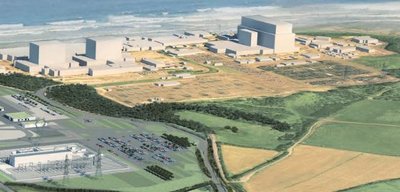
Hinkley Point nuclear power station project (Photo: EDF Energy)
Commission Vice-President in charge of competition policy, Joaquín Almunia, said:
“After the Commission’s intervention, the UK measures in favour of Hinkley Point nuclear power station have been significantly modified, limiting any distortions of competition in the Single Market. These modifications will also achieve significant savings for UK taxpayers. On this basis and after a thorough investigation, the Commission can now conclude that the support is compatible with EU state aid rules.”
UK including nuclear energy in its future mix
According to European Union Treaty legislation, Member States are free to choose their own energy mix. The UK has decided to include nuclear energy as part of its future energy mix.
However, when public money is used to support companies, it is the Commission’s duty to check that this is done in line with EU state aid rules, the Commission stressed.
The UK government plans to establish a price support to make sure the Hinkley Point nuclear plant operator receives stable revenues for 35 years. The operator will also receive a State guarantee on any debt it seeks to obtain on financial markets to finance the construction of the plant.
The Commission agreed that UK authorities had properly demonstrated that the support would “address a genuine market failure, dispelling the Commission’s initial doubts. In particular, the promoters of the project would not be able to obtain the necessary financing due to its unprecedented nature and scale.”
The nuclear power plant is to be built by EDF Energy. It will be the first nuclear power project in nearly two decades.
The £24.5 billion estimate is much higher than EDF’s original £16 billion, which includes the impact of inflation plus interest costs for the 10 year period it will take to build the plant.
EDF Energy, based in London, is a wholly owned subsidiary of French state-owned EDF SA (Électricité de France). It has operations spanning electricity generation and the sale of electricity and gas to households and businesses across the United Kingdom.
EDF employs 13,158 workers and has 5.7 million customers.
Video – Hickley Point nuclear power station virtual tour
This UK Government walkthrough video of Hickley Point has no sound.
