
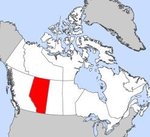
Saskatchewan and Alberta, or Western Canada, offer better job and career prospects for young Canadian adults while Quebec and Ontario have become as economically stagnant as Atlantic Canada, says a new report published by the Fraser Institute, a Canadian public policy think-tank.
Study author and senior fellow at the Fraser Institute, Mark Milke, said:
“Western Canada is the land of opportunity while Ontario and Quebec, the two most populous provinces, now resemble Atlantic Canada with its gloomy economic outlook and relatively poor prospects for young people.”
The study – “Go West, Young Adults: The 10-Year Western Boom in Investment, Jobs and Incomes” – looked at a range of economic indicators to compare all ten provinces, including private sector investment, income levels, employment rates, and population patterns, to determine levels of opportunity for young adults.
Alberta had a net influx of 60,855 young adults aged 25 to 34 years between 2003 and 2012 from other parts of Canada. Over the same period British Columbia had a 10,643 net influx and Saskatchewan 581.
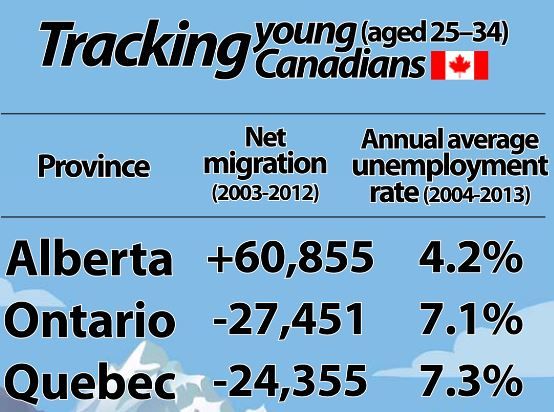
Infographic: The Fraser Institute.
Ontario, on the other hand, had a net exodus of Canadians of the same age over the same period, while Quebec lost 24,355.
Mr. Milke said:
“The statistics clearly show a steady exodus of young Canadians from provinces in Central and Eastern Canada to the greener pastures of the West.”
The main reason young adults have been migration west has been jobs. Over the 2004-2013 period, average annual unemployment rates among young adults (25-34 years) in Alberta was 4.2%, and in Saskatchewan 4.8%. In Quebec and Ontario, rates were 7.3% and 7.1% respectively.
Ontario’s long-term unemployment rate is higher than in Labrador and Newfoundland. Long-term unemployment or hardcore unemployment refer to people who have been jobless for over 12 months.
In 2012, the latest statistical year available, average per person income in Alberta was $52,207, compared to $37,106 in Quebec and $40,838 in Ontario.
Private sector investment in Alberta in 2012 was $60.5 billion, versus $25.7 billion in Quebec and $43.1 billion in Ontario.
Mr. Milke said:
“Clearly, where there’s more private sector investment there are more jobs and greater opportunities for young Canadians to enjoy a middle-class lifestyle.”
Labrador’s and Newfoundland’s fortunes appear to be improving – both provinces have reported an increase in private sector investment, per person income and weekly wage rates, but they cannot compare to what the West has to offer.
A young Canadian looking for full-time employment and the possibility of a middle-income salary or better “has a much better shot in Western Canada,” Mr. Milke concluded, “Ontario and Quebec are not providing opportunities for young adults and have been losing their best and brightest to the dynamic, opportunity-rich economies of Western Canada.”
