

The American general public views scientific issues completely differently from the country’s scientists, says a new pair of surveys by the Pew Research Center, carried out in collaboration with the American Association for the Advancement of Science (AAAS).
The report (citation below) found considerable differences in views on 13 science-related themes.
When asked whether they thought genetically modified foods were safe, 88% of AAAS scientists said they they were, while only 37% of the general public felt the same.
Only 47% of the general public agreed with using animals in research, compared to 89% of scientists.
Just 28% of US citizens thought it was safe to eat foods grown with pesticides, versus 68% of scientists.
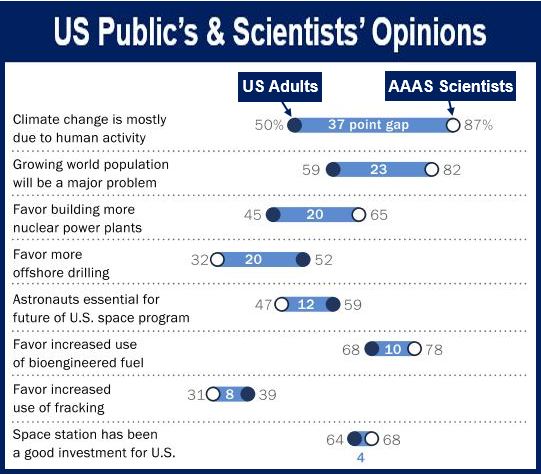
Surprisingly, Americans overall are less convinced humans are mostly to blame for climate change. Fifty percent of the overall population believes human activity is mostly to blame, compared to 87% of scientists.
Sixty-five percent of the general public believes humans have evolved over time, versus 98% of scientists.
The differences in opinions between the public and scientists are apparent in all directions, the surveys found. Citizens are more likely to favor offshore oil drilling by a 20-percentage point margin compared to scientists, and by a 12-point margin when asked whether astronauts are essential for the future for the US space program.
Lead author, Cary Funk, who is associate director of science research at Pew Research Center, said:
“Science is a huge, sprawling cluster of subjects. We knew from the 2009 Pew Research Center study that there could be differences between the public and scientists on at least some issues. But we were surprised by the size of those differences and how often they occur.”
Both agree that schools are failing in science
Both scientists and the public agree that elementary and secondary schools are not performing well regarding science, technology, engineering and math education (STEM).
Just 29% of the general public and 16% of AAAS scientists rate US K-12 STEM education as above average or the best in the world.
The majority of AAAS scientists (three-quarters) say too little STEM education is a major contributory factor in the public’s poor knowledge about science. Most scientists see this as a problem for science in general.
Co-author and Pew Research Center director of internet, science and technology research, Lee Rainie, said:
“Whatever their disagreements, most in the public and science community see STEM education as a concern. When both groups basically speak in the same voice about an issue, it is worth paying attention.”
Public less upbeat about US science today
Compared to the Pew Research Center’s findings in its previous survey in 2009, both groups are less optimistic about the US’ standing as a center of science in the world today.
While most of the respondents from the general public see scientific achievement in positive terms, only 54% today believe US scientific achievements are the best in the world or above average, compared to 65% in 2009.
Seventy-nine percent of adults feel science has made life easier for most people, 79% believe it has a positive effect on the quality of the country’s health care, the environment (62%) and food (62%).
Compared to 2009, the percentage of people mentioning the contribution of science in a negative light has increased.
While 76% of AAAS scientists in 2009 said this is generally a good time for science, only 52% think so today. When asked whether the current environment is good for their scientific specialty, only 62% of scientists today agree, compared to 73% in 2009.
The decline in views about the state of science over the past five years has occurred among US scientists of all disciplines.
Ms. Funk said:
“While the public is still broadly positive about the contributions of science to society, there has been a slight rise in negative views across a number of measures, suggesting some softening in the perceived value of science to society. These patterns will be important to watch over time.”
Michael Dimock, president of the Pew Research Center, said:
“The publication of this report begins a major new initiative for the Pew Research Center. The center has covered science-related issues in the past, but this marks our more formal commitment to studying the intersection of science with public life.”
“There is considerable interest in the policy community, among scientists themselves, and among engaged citizens to understand how the fast-paced world of scientific inquiry and innovation is shaping our world. We hope to explore that and to understand more fully how news and information about scientific activities makes their way to citizens, how they understand it, and how, in some circumstances, they contribute to it.”
Citation: “Public and Scientists’ Views on Science and Society,” Cary Fund and Lee Rainee. Pew Research Center. January 29, 2015.
