

UK synthetic biology at the Manchester Institute for Biotechnology is to receive an investment of £40 million, Business Secretary Dr. Vince Cable announced, where researchers can carry on investigating how to use bacteria to replace fossil fuels to produce chemicals required for the manufacture of a wide range of everyday products, from nappies (US English: diapers), to credit cards to Tupperware tubs.
Thirty-two million pounds will go towards establishing three new Synthetic Biology Research Centres at the University of Warwick, the University of Manchester, and the University of Edinburgh.
All three new centres will receive funding over the next five years to bolster national research capacity and to make sure the country has the necessary expertise to nurture the expanding synthetic biology industry in the UK.
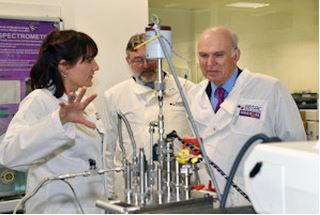
Dr. Vince Cable MP (right) speaking to Professors Perdita Barran (left) and Douglas Kell at the University of Manchester’s Institute of Biotechnology. (Image: University of Manchester)
The Biotechnology and Biological Sciences Research Council (BBSRC), the Medical Research Council (MRC), the Engineering and Physical Sciences Research Council (EPSRC), and the UK Government, which together are funding the ₤32 million’s worth of grants, also announced an additional ₤8 million to go towards research partnerships across the country to help create the DNA starting blocks needed for synthetic biology applications.
The funding will build capacity in DNA synthesis through partnerships at The Genome Analysis Centre, Imperial College London, and the universities of Southampton, Birmingham, Bristol, Oxford, Liverpool Edinburgh and Cambridge.
Dr. Vince Cable, said:
“From materials for advanced manufacturing to developing new antibiotics and better tests for diseases, this new £40 million investment is in one of the most promising areas of modern science.”
“It will see our world class researchers using bacteria to produce chemicals to make everyday products like toothbrushes and credit cards, which are currently made from unsustainable fossil fuels. Not only will this help improve people’s everyday lives in the future but it will support long-term economic growth.”
Synthetic biology – a new way of doing science
Synthetic biology, which applies engineering principles to biology to make and build new biological parts, devices and systems, is a new way of doing science, Dr. Cable explained.
Synthetic biology is being used to make biological ‘factories’ that make products we need, such as green energy, chemicals and medications, as well as tools for improving crops.
Examples of what synthetic biology can create include anti-malaria medications made by bacteria or yeast, and biofuels.
“Synthetic biology has been identified by the UK Government as one of the ‘Eight Great Technologies’ in which Great Britain can be a world leader,” Dr. Cable added.
Chief Executive of EPSRC, Philip Nelson, said:
“Synthetic Biology is a multi-disciplinary field that needs world class research and skills if progress is to be made. Previous government investments through the research councils have put us at the leading edge in this area. These centres are yet another example of how investing in science and engineering can strengthen the UK’s long term economic future.”
Chief Executive of BBSRC, Jackie Hunter, said:
“Through previous investments BBSRC, along with funding partners, has been able to position the UK as a world leader in synthetic biology. This new package of investments will ensure that the UK maintains this leadership position and continues to drive the potential of synthetic biology to contribute to the economy and society.”
The new centres will be funded from £10.6 million capital investment from the Autumn Statement (2012), £0.7 million from the MRC, £10.8 from EPSRC, and £10 million from BBSRC.
The funding will be awarded as follows:
£10.2 million: SYNBIOCHEM at Manchester University.
£10.5 million: Warwick Integrative Synthetic Biology Cetre (WISB).
£1.3 million: Imperial College London.
£2.4 million: Edinburgh and Liverpool Universities.
£2 million: Cambridge and Edinburgh Universities, and the Genome Analysis Centre.
£2.2 million: Birmingham, Bristol, Southampton, Oxford and Liverpool Universities.
Professor John McCarthy, of the University of Warwick’s School of Life Sciences and Director of WISB, said:
“We are delighted to receive this strategically important UK Synthetic Biology Centre Award. Synthetic biology has huge potential to generate valuable processes and products for biotechnology and medicine, as well as new understanding of the fundamental principles that underpin living systems. WISB is building a globally recognized presence as a centre of excellence in research and training in Synthetic Biology, and this grant from BBSRC and EPSRC will help us enormously in achieving our goals.”
Video – Vince Cables talks about synthetic biology
