

The long-awaited Abbvie Shire takeover was agreed on Friday. The deal, worth £32 billion ($54.7 billion), or £53.2 ($91) per share, was agreed by the board of directors of both companies. Abbvie’s HQ will move to the UK.
Under the terms of the merger, Shire shareholders will be entitled to receive:
- £24.44 in cash, and
- 0.8960 new Abbvie shares.
When completed, the new entity will have annual sales of almost $25 billion, approximately 30,000 workers, and a market value of over $137 billion, making it one of the 50 biggest companies worldwide.
Richard A. Gonzalez, Chairman of the Board and CEO of AbbVie, said regarding the merger:
“By combining AbbVie and Shire, we’re creating a unique, diversified biopharmaceutical company. The combined company would benefit from a best-in-class product development platform, a stronger pipeline and more enhanced R&D capabilities.”
Susan Kilsby, Chairman of Shire said:
“We believe that this offer reflects the substantial value that we have already created for Shire’s shareholders and the strength of our future prospects. We believe that the combined group represents an exciting fit of two complementary businesses that will create a new market leader in specialty pharmaceuticals with a portfolio of fast growing products, a promising pipeline and enhanced growth prospects.”
Abbvie moving HQ abroad
Chicago-based Abbvie will move its domiciled headquarters to the UK, where corporate tax (21.5%) is much lower than in the US (40%). The US has the highest corporate tax rate in the world.
On a call with analysts, Richard A. Gonzalez, Abbvie’s CEO, said:
“It will be domiciled in the U.K. for tax purposes. This structure provides AbbVie with flexible access to its global cash flows.”
Several US lawmakers, such as Senator Bernie Sanders, an independent from Vermont, urged the US government to penalize companies that moved abroad for tax reasons by withholding contracts.
Tax inversion problem is the US government’s own fault
Tax inversion typically occurs when a US company buys a major shareholding in a foreign firm and becomes its subsidiary, so that it can fall under the beneficial tax laws of the other country.
Most business people everywhere and lawmakers in other countries comment that if you “squeeze people till the pips squeak,” like the UK left-wing governments did in the 1970s, you end up collecting less tax because people and businesses go abroad.
The solution, rather than introducing new penalties to maintain a high tax regime which is obviously not working, is to make the US system more business friendly, i.e. bring its corporate tax rates more in line with the rest of the world.
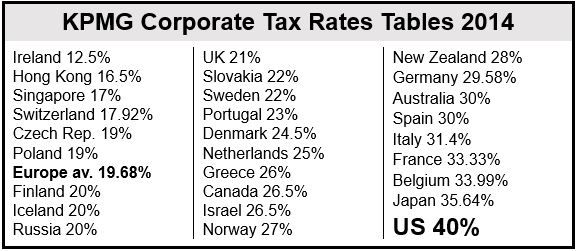
No wonder US-based companies are trying to get out! (Source: KPMG)
New York-based Pfizer, the largest pharmaceutical company in the world, tried for several months to buy the UK’s second largest drugmaker, AstraZeneca. The US company even wrote to Prime Minister David Cameron with a string of pledges and assurances. One of its directors had mentioned the tax benefits of decamping to London. Pfizer’s quest failed.
Earlier this month, Illinois-based Archer Daniels Midland (ADM) and Wild Flavors, a Swiss supplier of natural ingredients to the food and drinks industry, agreed on an all cash $3.13 billion (€2.3 billion) acquisition deal. So far, ADM has made no mention of moving its HQ to Switzerland, where corporate tax is 17.92%, but most analysts expect the company to do so soon.
The Council on Foreign Relations wrote in May that the US tax system encourages companies to keep their money abroad. Over the last thirty years all the advanced economies have overhauled their tax systems except for the US.
There is some bipartisan agreement in the US that reducing the corporate tax rate and taxing profits made by American companies abroad differently would help “move the tax system in the right direction.”
Jacob J. Lew, US Treasury Secretary, sent letters last Tuesday to senior member of Congress urging them to pass laws halting tax inversions and introducing retroactive penalties. His proposal was opposed by Utah Republican Senator Orrin G. Hatch, a ranking member of the Senate Finance Committee, who disagrees with retroactive penalties.
