
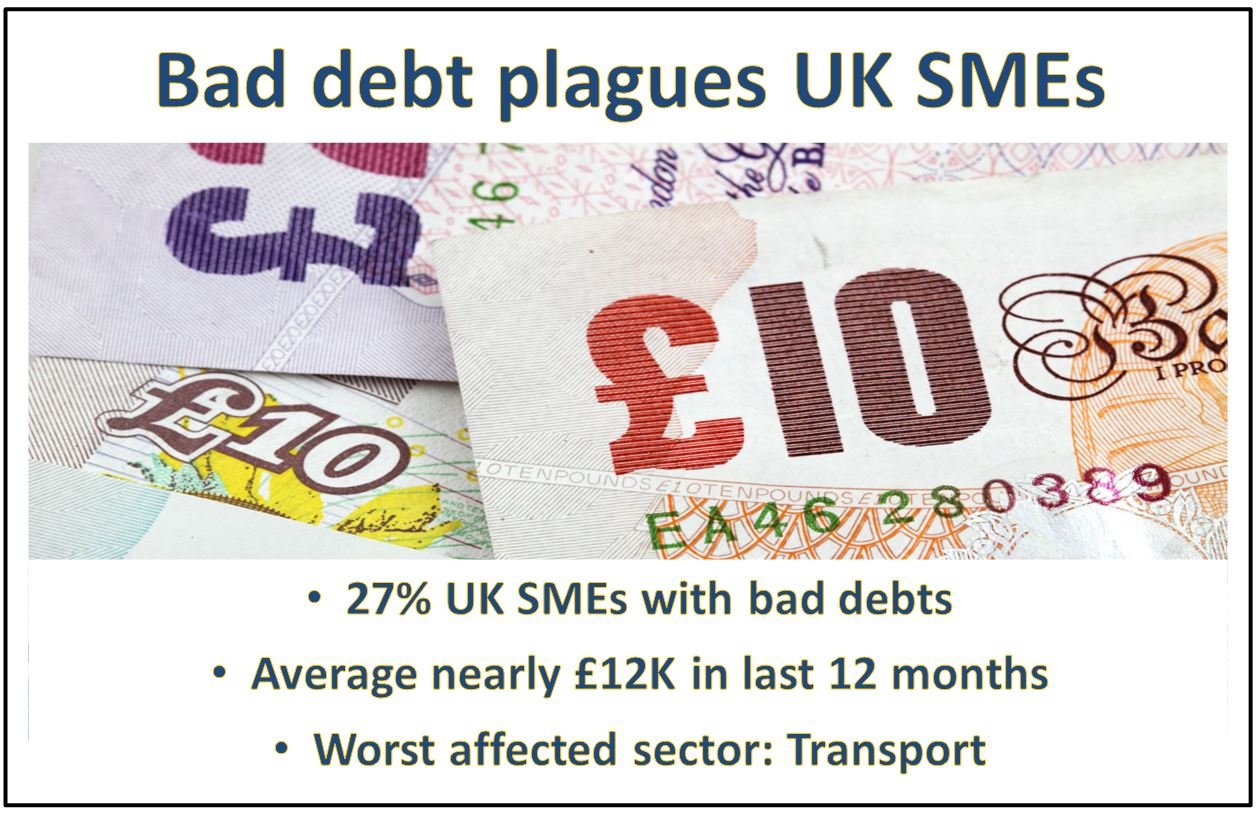
Bad debt – where customers do not pay their bills – continues to plague a significant number of UK SMEs, according to a report that finds over a quarter of them have suffered from the problem over the past 12 months.
A 2016 second quarter study, by small and medium enterprise (SME) funding specialists Bibby Financial Services (BFS), finds that 27 percent of UK SMEs had written off debts in the previous 12 months.
BFS, who conducted the research before the Brexit referendum vote to leave the EU, say the findings equate to 1.4 million SMEs suffering from bad debt during the last year.
The average amount written off by each SME in the past 12 months due to non-payment of invoices was £11,829.
SMEs in the transport sector were the worst affected (30 percent), closely followed by SMEs in the construction sector (29 percent), where the average write-off was nearly £15,000.
 The report’s finding equates to 1.4 million UK SMEs suffering from bad debt during the last 12 months.
On a regional basis, small and medium enterprises in Scotland and the West Midlands were the
worst affected, with three out of 10 SMEs experiencing bad debts in both regions.
In larger SMEs – with turnovers in excess of £5 million – the average debt write-off in the last 12 months was over £25,000.
On a slightly more positive note, the BFS Q2 report shows that the average time taken by customers to pay invoices from SMEs dropped to 38 days – down 2 from the 40 days reported for Q1. However, it is still a week longer than the 31 days reported for Q1 of 2014.
Small Business Commissioner
One of the measures of the new Enterprise Act, which came into force on 4 May 2016, is to establish a statutory Small Business Commissioner to help small firms resolve issues such as late payment.
However, it is not clear how the recent government changes – new leadership, ministers and revamped departments – will affect such measures.
David Postings, global chief executive of BFS, urges:
“Now is an ideal time for the new Secretary of State for Business, Energy and Industrial Strategy to set out the Government’s support plans on critical issues for SMEs, such as late and disputed payments.”
There is evidence that small businesses are increasingly turning to the law to chase bad debts. Research released earlier this year suggests the average value of county court judgements pursued by SMEs in the second half of 2015 was £4,619.
Time for more planned approach
Bad debts and late payments cause immense problems for small businesses who rely on cash coming in to pay salaries, replenish stock and fund expansion. If they cannot bridge the gap in cashflow caused by bad debts with financing, they can struggle to survive.
One reason non-payments occur is because of customer insolvency. A report issued earlier this year by R3, the trade body for insolvency professionals, revealed that medium-sized UK enterprises – that is those with 51-250 employees – were most likely to have been exposed to another firm’s or individual’s insolvency, with 14 percent these SMEs owed money by an insolvent individual or company.
Postings says there is clearly some anxiety among SMEs – as in the wider economy – following the UK’s referendum vote to leave the EU.
“But now,” he adds, “is the time for businesses to take growth and stability into their own hands and this must start by taking a more planned approach to chasing payment and protecting themselves against the effects of bad debt.”
