
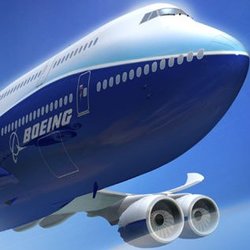
Boeing revenue increased by 8% to $20.5 billion in the first quarter of 2014, the company reported. Core earnings per share rose 14% to $1.76 (excluding $0.19 per share for 2013 R&D tax credit recorded in Q1 2013).
Boeing’s Q1 2014 core operating earnings (non-GAAP) increased to $2.1 billion, a rise of 12%, while its core operating margin (non-GAAP) rose to 10.2%.
Boeing Chairman and CEO Jim McNerney said:
“Disciplined execution across our production and development programs produced strong first quarter results. We measurably increased revenue, core operating earnings and cash flow, and expanded core operating margins. This financial and operational strength enabled the return of more than $3 billion to shareholders in the quarter through share repurchase and an increased dividend, even as we continued to invest in our future.”
“Our outlook for the full year remains positive on the strength of demand for our fuel-efficient new commercial airplanes, our solid position in global defense, space and security markets, and our enterprise focus on meeting customer commitments, improving productivity and profitably delivering the growth in our sizable backlog.”
Boeing revenue increased with rising aircraft production
Increased jet aircraft production helped Boeing achieve a 14% rise in adjusted net profit in Q1 2014, beating most estimates. On a non-adjusted bases, however, its profit declined 13% to $965 billion ($1.28 per share), compared to $1.11 billion ($1.44 per share) in Q1 2013.
The company’s increased revenues were more than offset by costs associated with its retirement plan changes.
Boeing delivered 161 commercial aircraft in Q1 2014, an 18% increase compared to the same quarter last year (131). The delivery figure reflects rising production rates for its best-selling 737 jetliner and 787 Dreamliner.
Huge backlog of orders
Boeing’s Commercial Airplanes division received 235 net orders during Q1 2014. By the end of March the division had a backlog of 5,100 aircraft worth $374 billion.
However, its income from the sale of military airplanes and space systems declined by 6% to $7.3 billion. Boeing Military Aircraft revenues dropped 13%, while Network & Space Systems revenue fell 4%, reflecting decreased satellites volume.
By the end of Q1 2014, Defense, Space & Security had accumulated a backlog worth $66 billion, 35% of which were overseas customers.
The company’s financial services arm also brought in less revenue ($82 million).
Core earnings outlook increased
Looking ahead, Boeing increased its outlook for core earnings for fiscal 2014 to a range of $7.15 to $735 per share, compared to a previous range of $7.00 to $7.20 per share.
Boeing forecasts deliveries for 2014 of between 715 and 725 aircraft. Capital expenditures for the year are projected to be approximately $2.5 billion and pension expense at $3.2 billion.
In an interview with Bloomberg Businessweek, Christian Mayes, an Edward Jones & Co. analyst in Des Peres, Missouri, said “They typically set a pretty low bar before they start the year. The quarter overall was pretty decent on both the commercial plane and defense side.”
Earlier this week Boeing announced a $4.6 billion order from Shandong Airlines, one of China’s smaller passenger carriers, involving fifty 737 airplanes.
The Boeing Company is one of the world’s leaders in the aerospace industry. It manufactures and sells electronic and defense systems, aircraft, rockets, satellites, launch systems, and advanced information and communications systems.
