

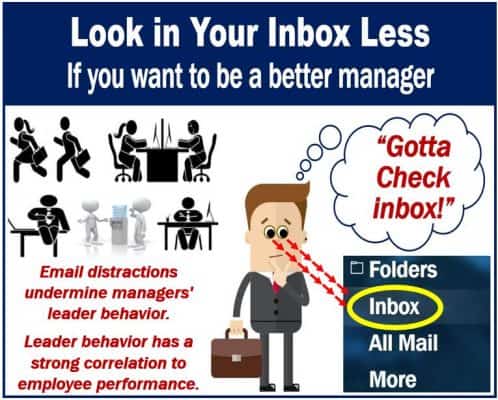
Bosses are getting boxed in by their email inbox. If you want to be a better boss, you should check your inbox less often, says a team of researchers.
Michigan State University researchers showed that keeping up with email traffic places very high demands on managers. Constantly checking their inbox prevents them from being good leaders. It also prevents them from achieving their goals.
Russell Johnson and colleagues wrote about their study and findings in the Journal of Applied Psychology (citation below). Johnson is an Associate Professor of Management in the Eli Broad College of Business at Michigan State University.
The authors say their study is one of the first to examine how distractions from emails affect managers and their productivity. It is also the first to examine how they impact managers as leaders.
Productivity refers to how much a unit of input produces over a specific period, such as per hour, day, week, etc. In this case, the term refers to managers.
Inbox affects all employees
Research has shown that employees spend over ninety minutes daily recovering from email interruptions. In other words, a total of 7.5 hours each week.
Managers, according to Prof. Johnson, are no different regarding their email inbox. Email distractions, the researchers add, have further-reaching implications.
Prof. Johnson said:
“Like most tools, email is useful, but it can become disruptive and even damaging if used excessively or inappropriately.”
“When managers are the ones trying to recover from email interruptions, they fail to meet their goals, they neglect manager-responsibilities, and their subordinates don’t have the leadership behavior they need to thrive.”
Managers also recover from overwhelming inbox demands by limiting leader behaviors. They also pivot to tactical duties. They do this deliberately, Prof. Johnson explains because it makes them feel more productive.
Prof. Johnson said:
“Interestingly, we found that managers scaled back ‘leader behaviors’ more so than initiating ‘structure behaviors.'”
“The former behaviors relate to motivating and inspiring subordinates, talking optimistically about the future or explaining why work tasks are important; the latter are more concrete and task-focused, such as setting work goals, assigning duties or providing feedback.”
So, by focusing too much on their inbox, managers are not managing properly. Furthermore, they are focusing on less important tasks so that they can feel more productive.
Determining how emails hinder managers
To find out how email demands undermine the performance of managers, the researchers gathered surveys from a group of 48 managers twice daily. They did this for ten consecutive working days.
Managers reported how often they checked their inbox and the demands of emails they received. They reported on their perceived progress regarding core job duties, how often they engaged in transformational leader behaviors and also initiating structure leader behaviors.
Prof. Johnson said:
“We found that on days when managers reported high email demands, they report lower perceived work progress as a result, and in turn engage in fewer effective leader behaviors.”
Subordinates suffer
Apart from failing to complete their own responsibilities, inbox distractions cause subordinates to suffer. Specifically, to suffer from a lack of leader behaviors or behaviors that inspire and motivate.
Prof. Johnson said:
“When managers reduce their leader behavior and structure behaviors, it has been shown that employees’ task performance, work satisfaction, organizational commitment, intrinsic motivation and engagement all decrease, and employees’ stress and negative emotions increase.”
There is a strong correlation between leader behavior and employee performance. Unfortunately, managers put these leader behaviors on a back burner because of inbox distractions.
Set aside specific times for the inbox
Prof. Johnson said:
“The moral of the story is that managers need to set aside specific times to check email. This puts the manager in control – rather than reacting whenever a new message appears in the inbox, which wrestles control away from the manager.”
“As we cite in the paper, findings from prior research suggest that it takes time and effort for employees to transition between email and work tasks, so minimizing the number of times they have to make that transition is to their benefit.”
Citation
“Boxed in by your inbox: Implications of daily e-mail demands for managers’ leadership behaviors,” Christopher C. Rosen, Lauren S. Simon, Ravi S. Gajendran, Russell E. Johnson, Hun Whee Lee, and Szu-Han (Joanna) Lin. Journal of Applied Psychology, Sep 17, 2018. DOI: http://dx.doi.org/10.1037/apl0000343.
