

Can cutting emissions save money because cleaner air would lower rates of asthma and other health problems? If so, how great would the savings be compared to the costs of reducing carbon emissions? CO2 (carbon dioxide) is the main type of carbon emission. CO2 is a greenhouse gas.
A research team from MIT examined three policies achieving the same reductions in emissions in the United States. They found that the health care savings as well as other lower costs associated with illness could be considerable – in some cases over ten times the money spent implementing a cleaner-air policy.
The study, titled “A systems approach to evaluating the air quality co-benefits of US carbon policies“, and authored by Tammy M. Thompson, Sebastian Rausch, Rebecca K. Saari and Noelle E. Selin, has been published in the journal Nature Climate Change.
Ms. Selin, an assistant professor of engineering systems and atmospheric chemistry at MIT, said:
“Carbon-reduction policies significantly improve air quality. In fact, policies aimed at cutting carbon emissions improve air quality by a similar amount as policies specifically targeting air pollution.”
Three policies compared
Selin and team compared the health benefits versus the economic costs of three climate policies:
- A clean-energy standard, requiring a reduction in emission from power stations similar to those proposed in the EPA’s Clean Power Plan. (CES)
- A transportation policy. (TRN)
- A cap-and-trade program. (CAT)
All three were designed to resemble proposed US climate policies.
Health savings identified across the 3 policies
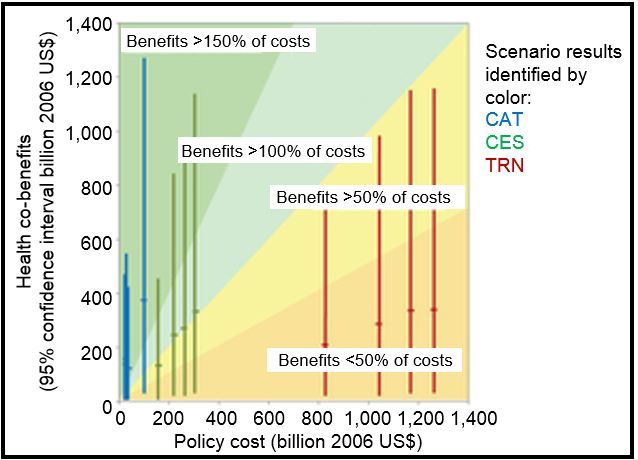
The team found that savings resulting from fewer health problems in the population could recoup 26% of the cost to implement a transportation policy, and up to 10.5 times the cost of a cap-and-trade program implementation.
As the savings due to fewer illnesses were similar in the three policies, the big difference was mainly in the costs of implementation.
Policies targeting specific sources of air pollution, such as vehicles and power plants, did not lead to significantly larger benefits than cheaper policies, like cap-and-trade.
Policy 1
The estimated $14 billion cost of implementing a cap-and-trade program is dwarfed by the savings from health benefits.
Policy 2
A transportation policy would cost over $1 trillion (in 2006 dollars) to implement, while the health benefits would only recoup approximately one quarter of the cost.
Policy 3
The cost of implementing a clean energy standard was between the costs of the other two policies, with the health benefits “edging out costs at $247 billion versus $208 billion,” the team wrote.
Lead author, Ms. Thompson, who is now at Colorado State University, said:
“If cost-benefit analyses of climate policies don’t include the significant health benefits from healthier air, they dramatically underestimate the benefits of these policies.”
Just the first step
Ms. Selin added:
“While air-pollution benefits can help motivate carbon policies today, these carbon policies are just the first step. To manage climate change, we’ll have to make carbon cuts that go beyond the initial reductions that lead to the largest air-pollution benefits.”
Countries across the world have agreed to set CO2 emission limits. Companies that exceed their emissions cap either have to pay a penalty or purchase leftover allowances from businesses with low emissions.
