
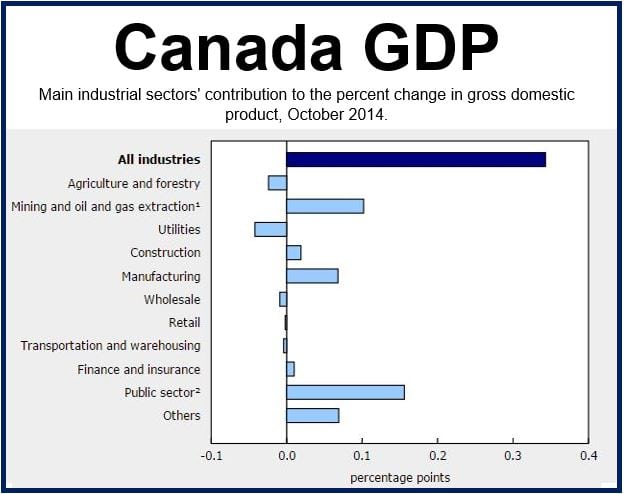
Canada’s gross domestic product (GDP) grew by 0.3% in October, a much higher figure than most analysts had expected, after expanding by 0.4% in September, Statistics Canada reported on Tuesday. Economists will now be revising their estimates for the fourth quarter of 2014.
Despite the good performance, the recent drop in oil and commodity prices do not bode well for the country next year. It is unlikely to post similar GDP growth in 2015 to 2014.
Goods production increased by 0.4% in October. Mining, oil & gas and manufacturing had a particularly strong month. Agriculture, forestry and utilities, on the other hand, contracted.
Service industry output grew by 0.3% in October, driven mainly by the public sector (public administration, health and education combined).
The wholesale trade contracted in October while retail remained the same.
The public sector, driven mainly by educational services, grew by 0.8% in October. Educational services posted a 2.6% increase, returning to normal levels following a labour dispute in September in British Columbia.
Oil & gas extraction, quarrying and mining increased by 1.2% in October, the second successive monthly increase. Oil & gas extraction was 1.5% up, driven by non-conventional oil production, while natural gas production fell.
Source: “Gross domestic product by industry, October 2014,” Statistics Canada.
Mining and quarrying (excl. oil & gas extraction) gained by 1.5% in October. Potash mining had a very strong month, more than offsetting the decline in zinc, lead, nickel and copper mining.
Support activities for oil & gas and mining fell by 1.6%, due mainly to a steep decline in drilling services.
Manufacturing output grew
Manufacturing output was 0.7% up in October, after increasing by 0.8% in September. The manufacturing of non-durable goods grew by 0.9% with most major industrial groupings posting gains. Coal and petroleum products, chemical as well as rubber and plastic products manufacturing had a good month, while food manufacturing contracted.
Durable-goods manufacturing was 0.4% up in October, driven mainly by fabricated metal products manufacturing, as well as furniture. The manufacturing of machinery and of primary metals fell.
