

Over the last couple of years, the US Federal Reserve (Fed) and other central banks across the world have been raising interest rates in their fight against inflation—that is, rising prices. Recently, they have done the opposite; they have begun to cut interest rates to help their economies expand faster.
If interest rates go down, borrowing gets cheaper, and consequently, spending by consumers and businesses rises. Central banks lower interest rates to boost the economy and raise rates to slow it down. In other words, when economic growth has slowed down too much, or if the economy is shrinking, central banks lower interest rates. When the economy is hot, that is, there is strong growth but inflation is also high, they tend to raise interest rates.
Currently, the US Federal Reserve, the European Central Bank, the Bank of England, the Bank of Japan, the Reserve Bank of Australia, and many more central banks are keeping interest rates steady or unchanged. According to TradingView, Nomura Holdings, a Japanese financial services company and investment bank, no longer expects the Fed to cut rates this year.
Why are interest rates staying high?
The conflict in the Middle East has caused the prices of oil and gas to rise sharply. Products derived from oil and gas, such as agricultural fertilizers, plastic packaging, synthetic fabrics, commercial asphalt, and industrial lubricants, have also become significantly more expensive. Overall inflation has been driven up by high oil and energy costs.
In the UK today (22 May 2026), one liter of gasoline at the pumps costs, on average, £1.58 (vs. about £1.32 before the Iran conflict); in the Eurozone, €1.82 (vs. about €1.62 before); and a gallon of gas in the US costs $4.55 (vs. about $2.98 before).
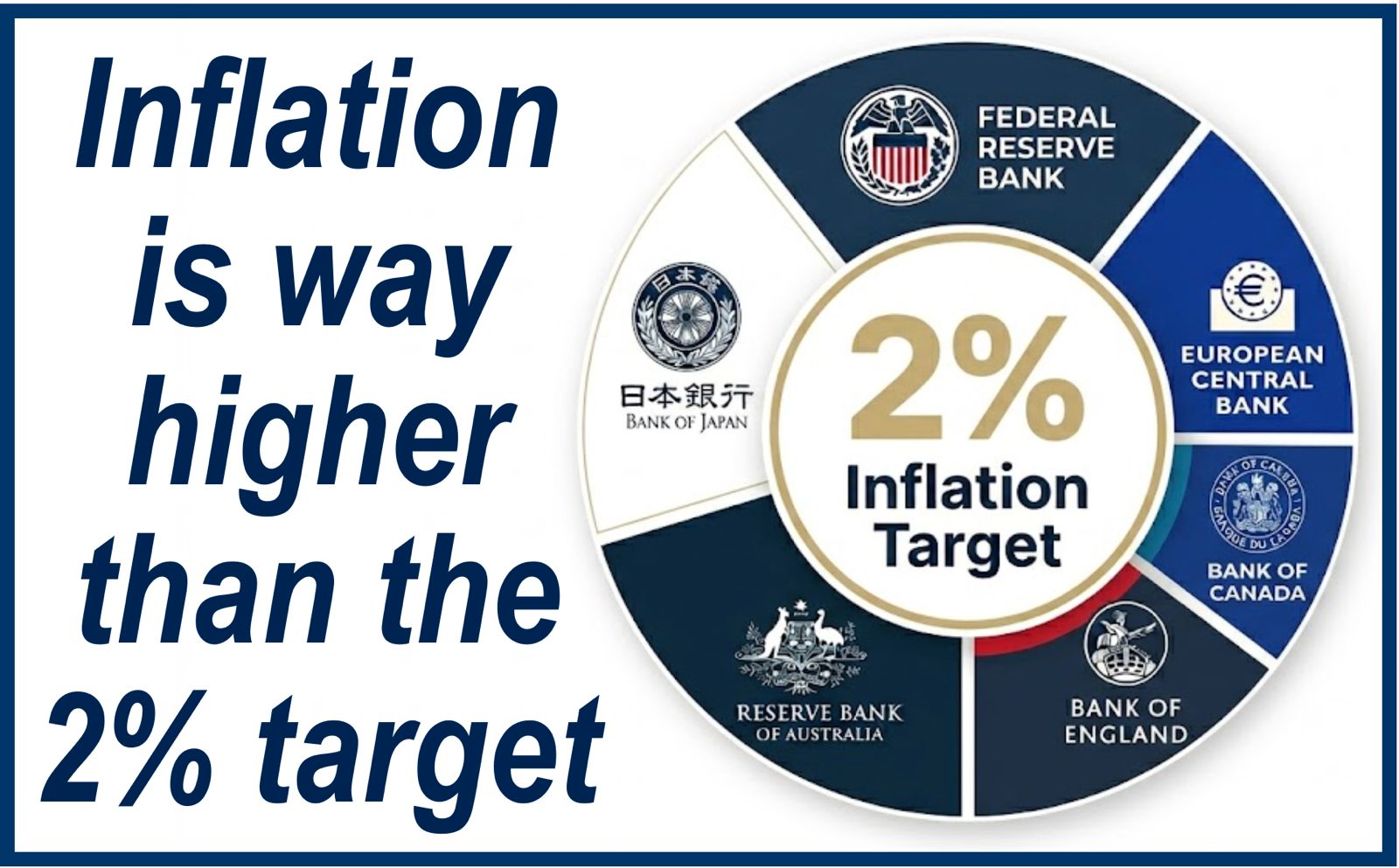
Central banks worry that inflation will remain high and they won’t be able to bring it back to normal targets. The world’s advanced economies, as well as many others, aim to keep annual inflation at or below 2%—we call that figure their target. At the moment, annual inflation is 3.8% in the US, 2.8% in the UK, 3.0% in the euro area, 4.6% in Australia, 2.8% in Canada, and 2.9% in Germany—they are all well above their central banks’ target of 2%.
The economic impact
The global economy is surprisingly strong despite high interest rates and consumer and investor concern about the Iran conflict and its potential consequences.
Some hawks in the US and some other countries are even pushing for higher interest rates, if necessary. Before deciding what to do next or determining whether to change their plans, financial institutions will watch all economic data closely.
None of us knows when interest rates might start coming down. Hopefully, it will be soon. Much of it depends on how quickly the Iran war will be over and whether oil and gas ships can sail freely and safely through the Strait of Hormuz.
Before the Iran conflict, the chances of the world sliding into a global recession stood at an average of about 25%. Today, estimates vary considerably, but most forecasts say the percentage risk is higher today than before the United States and Israel attacked Iran. Economist Mark Zandi, from Moody’s Analytics, recently raised his probability of recession to 49%.
