
Cheap steel is putting hundreds of thousands of US jobs at risk as the US steel industry plunges into an import crisis, says a new study published by the Economic Policy Institute and law firm Stewart and Stewart.
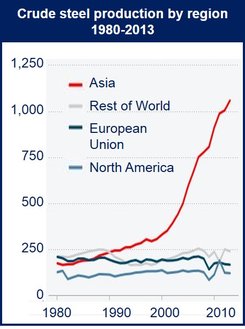
The authors of the study – Surging Steel Imports Put Up To Half a Million US Jobs at Risk – explain that during and after the Great Recession, state-owned steel companies in India, South Korea, China and some other nations ramped up production even though demand had declined.
Global glut of steel production capacity
There is a global glut of steel production capacity and the US has become a prime target for manufacturing exporters to dump excess steel at artificially low prices.
Since 2011, steel prices have plunged while US steel imports have surged, putting up to half a million US steel-related jobs at risk.
Terence P. Stewart, Managing Partner of Stewart and Stewart, said:
“The excess capacity plaguing the steel industry is a result of massive government support for the steel industry in other countries. Half of the world’s top steel companies are state-owned.”
“These companies have ramped up capacity and are producing much more steel than the market demands. The U.S. steel market is the number one target for offloading excess supply.”
State-owned steel companies told to keep producing more
Because of the steel industry’s capital intensity, high fixed costs, as well as the large scale of steel production, state-owned steel companies are told to keep production levels up, even if this exceeds domestic demand, and to export the surplus at artificially low prices.
This excess production is being directed at the US steel market because of its size and openness. In 2011, the US imported 28.5 million net tons of steel, which increased to 32 millionin 2013.
In January and February 2014, US steel imports were 25% higher than during the first two months of 2013.
Steel industry vital for US economy
Economic Policy Institute’s Director of Trade and Manufacturing Policy Research Robert E. Scott, said:
“The steel industry is hugely important to the U.S. economy. It directly supports half a million jobs, and those jobs are in imminent danger. The import surge has led to sharp declines in income in the steel industry, layoffs for thousands of workers, and reduced wages for many more.”
The import crisis plunged the US steel industry into a net loss of $388 million in 2012, and $1.2 billion in 2013. In four of the last five years the US steel industry has seen net losses.
If the US does not comprehensively and effectively enforce its trade remedy laws, which have historically been crucial for the survival of the steel industry, 583,600 American steel-related jobs are under threat, the authors wrote.
Elizabeth Drake, Partner at Stewart and Stewart, said:
“The United States should vigorously enforce its trade remedy laws to counteract the dumping and subsidization that gives imported steel products an unfair advantage in the U.S. market. Trade remedies were essential in helping the U.S. steel industry survive its last import crisis, and their effective enforcement is equally critical today.”
