

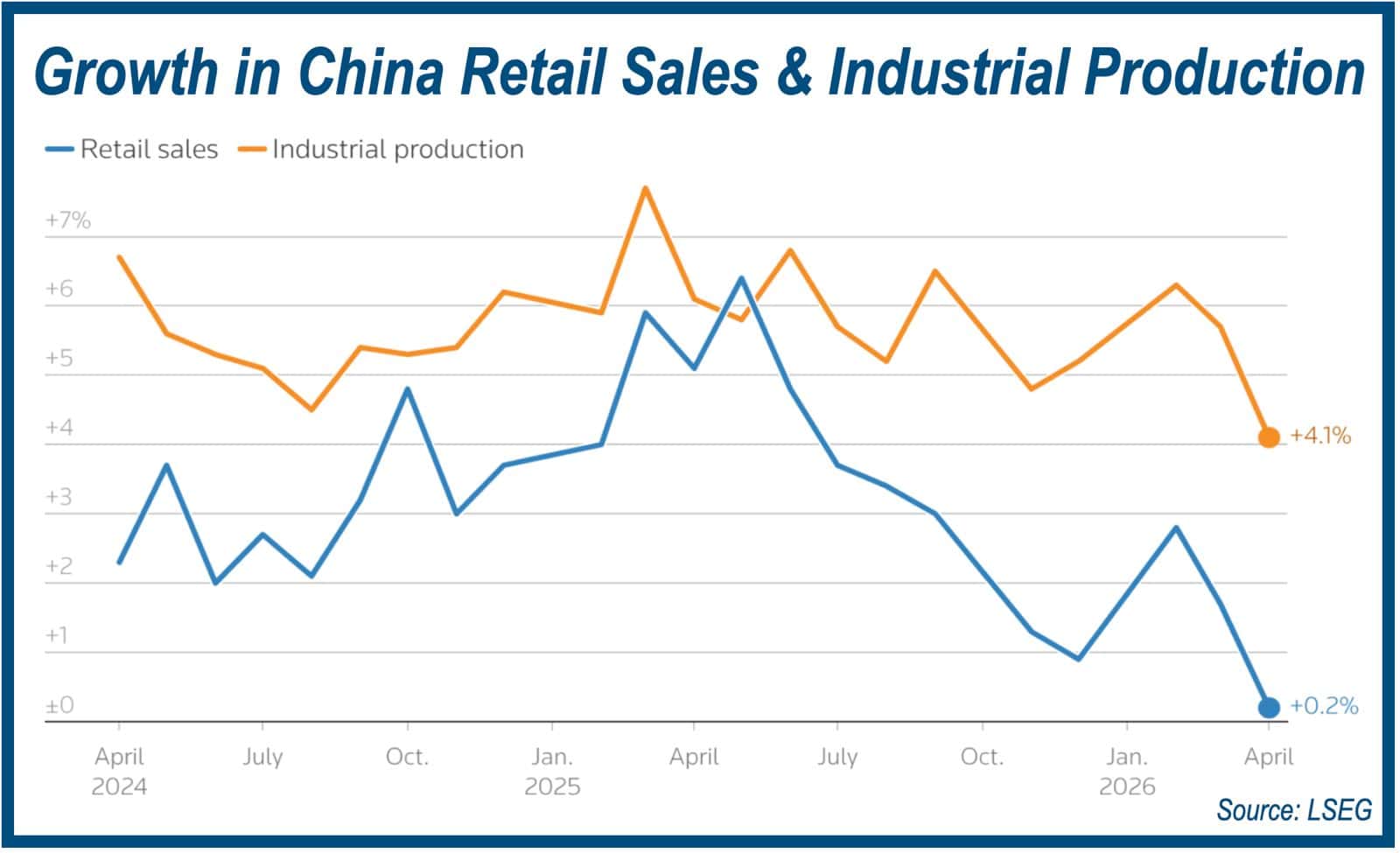
In China, retail sales year-on-year in April 2026 slowed sharply to 0.2% growth, surprising analysts. International brokerages and Wall Street were not expecting a boom; however, they had forecast significantly higher growth for April. According to Reuters, a consensus of forecasters had predicted an average of 2% expansion. In other words, analysts had expected growth ten times greater than reality.
April’s retail figures fell dramatically from 1.7% in March. This slowdown represents China’s slowest retail growth in four years.
Auto, furniture, and jewelry lead the slump
According to ING, this weakness has been driven by a wide range of categories, including automobile sales, household appliances, furniture, and jewelry sales.
Domestic vehicle sales, which had already been sliding, were 15.3% lower in April 2026 compared to April 2025. Household appliances shrank 15.1%, furniture sales fell 10.4%, while a decline in global gold prices triggered a jewelry plunge of 21.3%.
Consumer staples rose
While the overall retail sector’s growth collapsed to 0.2% year-on-year in April, groceries and eating out increased at much higher rates. Alcohol and tobacco sales rose by 11.7%, grains and oils by 4.1%, beverages by 3.6%, and catering (dining out & food services) by 2.2%.
All this data suggests that consumers in China are exhibiting defensive spending behavior—nearly halting big-ticket discretionary purchases such as cars and furniture, and focusing their spending on daily food, beverages, and household necessities.
The Iran War Impact
Virtually every country in the world has been negatively affected by the US-Iran war, which started in late February 2026 and is still ongoing. China is no exception.
Gold prices skyrocketed when the Iran war began, due mainly to panic buying as people looked for safe havens for their money. As the panic subsided and consumers and investors began to realize that the war would most probably remain localized, prices settled at a cheaper and steady level.
When gold prices stopped climbing, Chinese consumers stopped panic buying—that was why there was a 21.3% decline in jewelry sales in April.
The war in Iran also disrupted China’s heavy industrial oil processing, that is, converting basic oil (petroleum) into oil products that we can use for our cars, ships, planes, factory machinery, etc. China has massive oil refineries, which rely heavily on Middle Eastern oil.
During the month of April, oil processing volumes were 5.8% down year-on-year. Domestic electricity and natural gas for cooking and heating became more expensive.
China’s consumers, investors, businesspeople, and policymakers, like virtually everybody else in the world, are hoping that the Iran conflict will end and that the Strait of Hormuz will be free and safe again. Nobody knows when this day will come.
