


Ask anyone who hosts their own phone system which open source PBX to pick and you’ll hear the same three names: FreePBX, Issabel, and Wazo Platform. The fourth name, ICTPBX, comes up the moment the conversation turns to selling hosted PBX to other businesses. Here’s the short version: FreePBX for a single company’s phone system, Issabel for an all-in-one comms server on a budget, Wazo for API-driven builders, and ICTPBX for white-label multi-tenancy that was designed in from day one, with a free open source community edition if you want to start on your own server today.
The Architecture Question Nobody Can Skip
Every platform here traces back to one decision: Asterisk or FreeSWITCH. Asterisk is the older, more famous engine with the bigger module ecosystem, and all three open source picks build on it. FreeSWITCH came later, designed specifically to scale as a switching core, with per-tenant isolation and high concurrent call counts as goals rather than retrofits. Neither engine is “better” in the abstract. But when the workload is many tenants on shared infrastructure, the engine’s attitude toward isolation starts to show. ICTPBX pairs FreeSWITCH with ICTCore, an open source communication framework published on GitHub, with an Angular front end on top.
The Four, Compared
| ICTPBX | FreePBX | Issabel | Wazo Platform | |
|---|---|---|---|---|
| Engine | FreeSWITCH + ICTCore | Asterisk | Asterisk | Asterisk |
| License | Open source community edition (MPL 2.0) + commercial multi-tenant | Open source (GPL) + paid modules | Open source (community-driven) | Open source (GPLv3) |
| Multi-tenant | Native, core design | No (one system per tenant) | No | Tenant support, API-first |
| White-label | Yes, full rebrand | Not a product goal | Not a product goal | Build-your-own branding |
| Browser calling | WebRTC softphone included | Via add-ons | Via add-ons | WebRTC in the stack |
| Billing + REST API | Integrated billing system, REST API | Third-party billing add-ons | Third-party | REST APIs, bring your own billing |
| Best fit | ITSPs selling hosted PBX under their brand | Single business phone system | SMB all-in-one comms server | Teams building custom telecom products |
FreePBX is the most installed open source PBX interface on earth, and for a single company’s phone system it’s hard to argue against. The community is vast, the documentation is everywhere, and the module store covers most gaps. But it isn’t multi-tenant, so a provider hosting fifty customers runs fifty FreePBX instances, with fifty upgrade windows. That’s a business model tax, not a technical detail.
Issabel picked up the torch Elastix dropped and kept the all-in-one dream alive: PBX, email, and collaboration tools on one server, maintained by a genuinely dedicated community. For a small business that wants one box doing everything, it’s a lovely deal. For a provider, the same single-tenant limitation applies, and the project moves at community pace.
Wazo Platform is the interesting one. It split from the XiVO lineage to become an API-first programmable telecom platform, and it’s the open source option that takes service providers seriously. The honesty required here: Wazo gives you the plumbing and expects you to build the product. If you have developers who enjoy that, it’s powerful. If you wanted to sell hosted PBX next quarter, you’ve just hired yourself as the integrator.
ICTPBX, from ICT Vision, comes in two flavors, and that changes its place in this comparison. The ICTPBX Community Edition is free and open source under MPL 2.0: a full IP-PBX you install on your own server, same FreeSWITCH engine, same web interface, no license fee. The commercial edition is where the provider story lives: native multi-tenancy, full white-label rebranding, and platform support. Tenants, DIDs, extensions, IVRs, ring groups, call recording, and a browser-based WebRTC softphone, all managed from one multi-tenant platform, with an integrated billing system for invoicing tenants and a REST API for provisioning them from your own portal. One platform, many tenants, one upgrade window. Start on the community edition, graduate to multi-tenant when you have customers to host.
AI Voice Agents: The New Line Item in PBX RFPs
PBX buyers started asking a new question this year: can the phone system answer intelligently before a human picks up? Not an IVR tree, an actual conversational agent. For multi-tenant providers this is a revenue question, because an AI answering layer is a service you can sell per tenant.
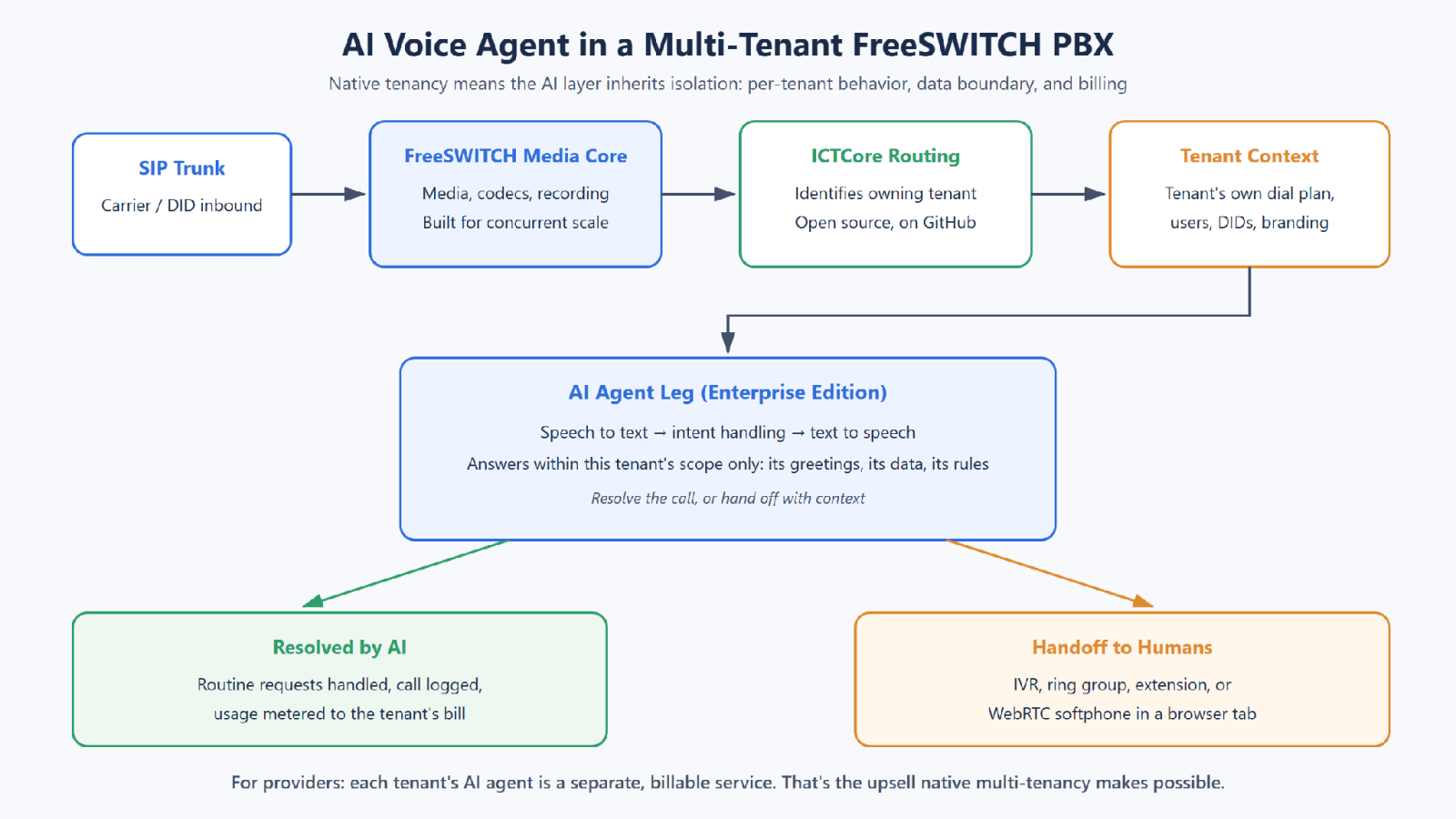
The architecture that makes this sellable: the SIP trunk lands on the FreeSWITCH media core, ICTCore routes the call into the owning tenant’s context, and within that tenant the call can hit a conventional IVR, ring group, or an AI agent leg that handles speech to text, intent, and text to speech before deciding whether to resolve or hand off to an extension or WebRTC softphone. Because tenancy is native, the AI layer inherits tenant isolation: each customer gets their own agent behavior, their own data boundary, their own billing meter. ICTPBX offers AI voice agent capability on its enterprise edition, and the per-tenant isolation is precisely what makes it packageable as an upsell. On the Asterisk platforms, comparable results come from third-party AI integrations wired per deployment, which works, but the per-tenant packaging becomes your engineering project instead of the platform’s feature.
Choosing in One Paragraph
One company, one phone system? FreePBX and be done. Small office that wants one server doing phones, mail, and more? Issabel earns its keep. Developers building a custom telecom product on open APIs? Wazo is your kit. Building a hosted PBX business under your own brand, with browser calling out of the box and an AI answering layer you can sell per tenant? That’s the brief ICTPBX was written to.
FAQ
Does FreeSWITCH really scale better than Asterisk?
For high concurrent call volumes and multi-tenant isolation, FreeSWITCH’s architecture was designed with those loads in mind and generally carries them with less tuning. Well-engineered Asterisk clusters absolutely scale too; the difference is how much engineering “well-engineered” requires.
Can I white-label FreePBX or Issabel for my customers?
Neither is built for rebranded resale; you’d be maintaining a fork. Wazo lets you build your own branded product on its APIs, at developer cost. ICTPBX treats full white-label as a product feature, which is the difference between hiding a logo and shipping your own product.
Why does a WebRTC softphone matter for hosted PBX?
Your tenants’ end users get calling in a browser tab with nothing to install, which removes the biggest support burden of onboarding remote and hybrid teams onto a phone system.
Is an AI voice agent standard on these platforms?
Not standard anywhere yet. ICTPBX ships it on the enterprise edition; on the open source Asterisk platforms you integrate third-party AI services per deployment. Either way, insist on per-tenant configuration and clean escalation to human extensions before selling it.
