
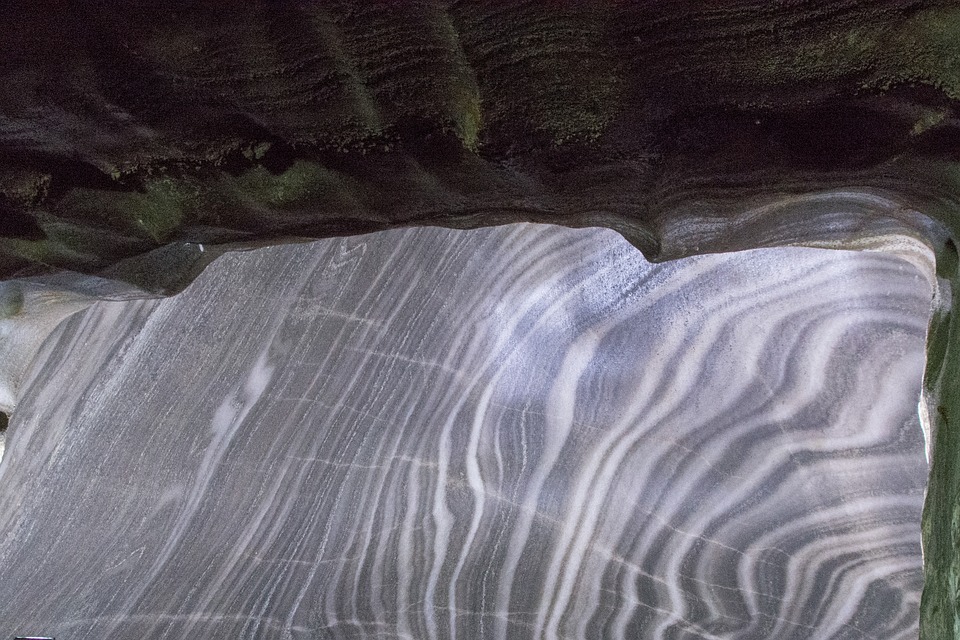
A European Union project is looking at using compressed air energy storage in sealed underground chambers – such as disused mines and caverns – so renewables can supply electricity to the grid in a controlled way.
Wind and solar farms make electricity when the wind blows and the sun shines. The electricity can be pumped into the grid as long as there is a demand, but when the supply exceeds the demand, then the energy must either go to waste or be stored to meet a later demand.
 Storing energy in underground chambers as compressed air could help control supply to the grid of electricity from renewables like wind and solar. Image: Turda salt mine cave, pixabay-1928523
These renewable energy sources cannot be turned up and down to match demand in the same way as traditional power stations that burn fossil fuels.
Thus, as Europe increases its capacity for wind and solar energy, so the need for energy storage or “batteries” increases.
In countries with mountainous regions and plenty of water, pumped hydropower plants are cost-effective batteries – excess energy pumps water uphill into a reservoir, and then water is allowed to flow downhill to generate electricity when needed.
Storing heat as well as air
The principle of compressed air energy storage is to use air instead of water as a way to store surplus energy. It attracted a lot of industry interest at the 2016 Future Energy Scenarios.
The idea is not new. However, what is more recent is the idea of storing heat with the compressed air, which increases the efficiency of the energy storage to the point where it becomes a more attractive proposition.
The two largest compressed air energy storage plants in the world are in underground salt caverns in Huntorf in Germany, and in McIntosh, Alabama, in the United States. However, both plants lose a lot of the energy that is converted because there is no capacity to capture the heat that is produced as the air is compressed.
Anyone who has pumped up a bicycle tyre is familiar with the two forms of energy generated: the compressed air in the tyre, and the heat that makes the pump hot.
Crushed rock chamber holds the heat
The participants of the European project – called RICAS 2020 – have devised a method for capturing and returning the energy in the heat as well as the energy in the compressed air. Essentially, there is an extra step, as follows:
– as the air is compressed (and gets hot in the process) it is sent underground to the storage chamber, but first it passes through a separate chamber full of crushed rock
– the hot air heats up the rock which conserves much of the heat
– the cooled air then passes to the main cavern for storage
– when the air returns, it warms up again as it passes through the crushed rock chamber
– the hot air is then expanded through turbines to generate electricity
Giovanni Perillo of SINTEF – a research company headquartered in Trondheim – is project manager of the Norway section of RICAS 2020. He explains:
“The more of the heat of compression that the air has retained when it is released from the store, the more work it can perform as it passes through the gas turbine. And we think that we will be able to conserve more of that heat than current storage technology can, thus increasing the net efficiency of the storage facilities.”
Increased efficiency
Perillo and colleagues believe that they can increase the efficiency of the system by 70-80 percent in this way, a considerable improvement on the 45-55 percent efficiencies of the older systems.
He reckons that with this kind of performance, compressed air energy storage can offer better energy storage than batteries, “thanks to its longer lifetime and lower capital cost per kWh of stored energy.”
The project participants suggest existing underground spaces that are no longer in use – such as disused tunnels and mineshafts – could be reopened for compressed air energy storage.
Perillo’s particular area of expertise is in developing a sealing membrane to make the compressed air energy storage chambers airtight.
There are many tests to carry out – for example pressure tests on the sealant – and further studies to complete before they can say whether it is feasible to go ahead with a pilot plant.
Perillo says if all goes well, then there could be other applications of the compressed air technology – not just for energy storage.
Hot energy storage could be the breakthrough that is needed
Dr. Matthias Finkenrath, an energy engineering professor at Kempten University of Applied Science in Germany, has been investigating compressed air energy storage for some time.
He says many have lost interest in the method because of the low efficiencies and uncertainties in the energy market. Many large-scale plans have been put on hold.
But, the hot energy storage system could get things moving again – by lowering costs and increasing capacity it becomes comparable to batteries. Also, if plants could be established in a wide range of geological conditions, that too would be a big step forward.
