

Scientists at the National Oceanic and Atmospheric Administration (NOAA) warned that warm ocean temperatures in the Indian and Pacific Oceans could trigger major coral bleaching worldwide in 2015.
This latest warning follows last year’s severe coral bleaching, and comes with the release of its most recent forecast from NOAA’s Coral Reef Watch, a weekly report that predicts the risk of coral bleaching up to four months in advance.
NOAA Coral Reef Watch coordinator, Mark Eakin, said:
“The new outlook gives us greater confidence in what it shows for future coral bleaching and it comes at an important time. The outlook shows a pattern over the next four months that is similar to what we saw during global coral bleaching events in 1998 and 2010. We’re really concerned that 2015 may bring the third global coral bleaching event.”
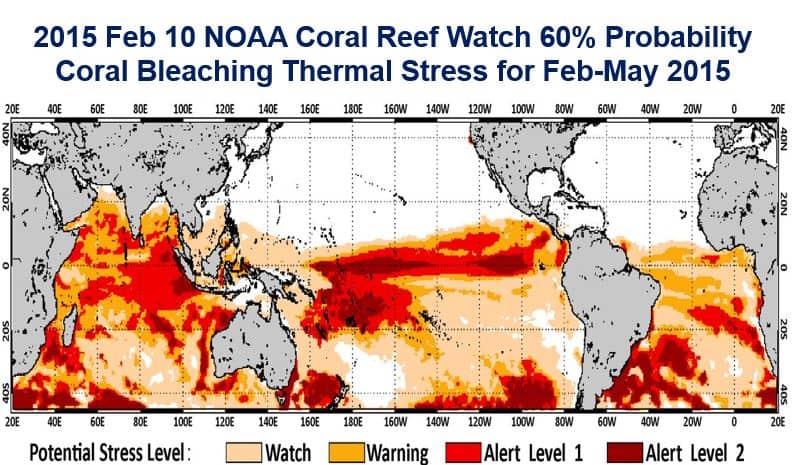
NOAA’s four-month bleaching outlook indicates the greatest threat for coral bleaching through May 2015 is in the western Pacific and Indian Oceans. (Image: NOAA)
Coral bleaching occurs when corals are stressed by changes in conditions such as nutrients, light or temperature. They expel the algae (zooxanthellae) that live in their tissues, causing the coral to become completely white.
When the coral bleaches it is still alive, it can survive a bleaching event. However, it is under stress, more susceptible to disease, and at greater risk of dying.
Top risks – Indian and Pacific Oceans
According to the outlook, up to the end of May 2015, the greatest threat for coral bleaching is in the Indian and western South Pacific Oceans.
Thermal stress in the Pacific has already reached levels that cause bleaching in the nations of the Solomon Islands, Kiribati and Nauru, and is forecast to spread to American Samoa, Samoa, and Tuvalu in the coming months.
In the Indian Ocean thermal stress is likely to reach bleaching-causing levels around parts of Indonesia, western Australia, Seychelles and Mauritius.
In the shallow reefs of American Samoa, NOAA scientists are already reporting the start of bleaching.
Mr. Eakin said:
“In the coming months, we will be watching to see if the model predicts conditions that can cause bleaching in Southeast Asia and the Coral Triangle region around mid-2015.”
The NOAA’s latest generation of the outlook is now able to cover greater areas of the globe, with better accuracy and finer resolution.
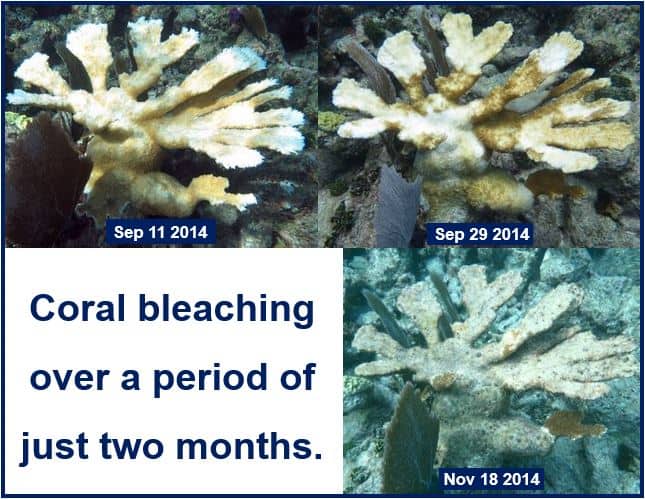
See how progressive bleaching affected a once healthy elkhorn coral (Acropora palmata) in Florida. (Image: NOAA)
The NOAA’s Coral Reef Watch program has improved its satellite observational capacity that provides near real-time data on the environmental conditions of coral reefs. It is now able to focus on reef areas just five square kilometers in size, with up to 50% more data than before.
Consequently, scientists and reef managers are now able to accurately pinpoint bleaching thermal stress levels at coral reef scales and respond with protective measures.
Jennifer Koss, acting program manager for NOAA’s Coral Reef Conservation Program, said:
“Climate change and its impacts, which can include bleaching, are some of the most pressing global threats to coral reef ecosystems today. This suite of products is vital to help scientists, coral reef managers, and decision makers in the U.S. and around the globe prepare for bleaching events.”
Update – 21 October, 2015: A team of scientists from the US and Israel say that oxybenzone, a compound found in sunscreens, is causing widespread destruction of coral reefs.
