
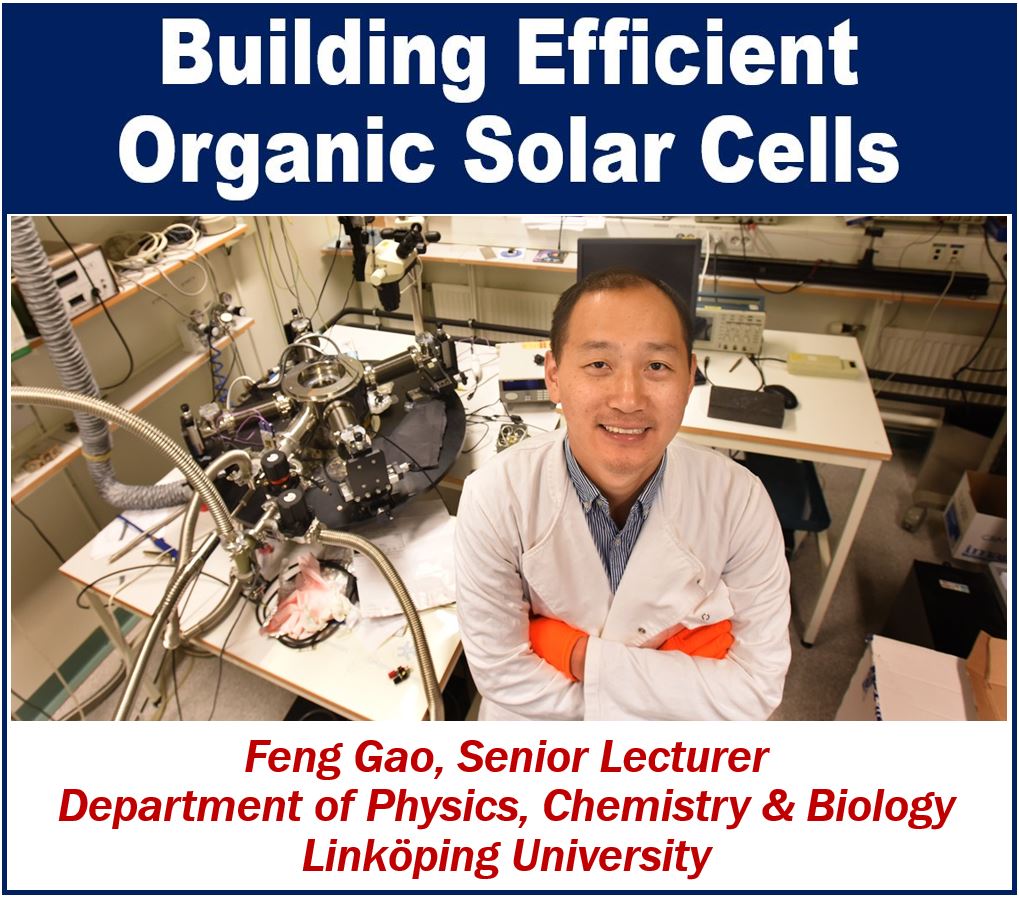
A large, international team of researchers has drawn up rules for creating efficient organic solar cells. Organic solar cells, which are made of carbon-based materials, have some unique advantages over other solar cell technologies. The research team included twenty-five scientists from seven research institutes in Europe, China, and the US. Feng Gao, associate professor at Linköping University, Sweden, led the research.
It is possible to manufacture organic solar cells through printing technologies. We cannot do this, however, with other solar cell technologies. Printing is a relatively low-cost way of manufacturing solar cells.
It is also possible to make organic solar cells in specific colors. They are therefore easier to use architecturally in building integration.
Their flexibility makes them ideal for powering the sensors for the ‘internet of things.’ Also, their low weight makes things much easier.
Organic solar cells – energy losses
The main challenge in organic solar cell development is energy loss, which is typically large.
Prof. Gao, who works at Linköping University’s Division of Biomolecular and Organic Electronics, said:
“We have formulated some rational design rules to minimize energy losses in organic solar cells. Following these rules, we present a range of examples with low energy losses and high-power conversion efficiencies.”
Prof. Gao and colleagues wrote about their research in the prestigious journal Nature Materials (citation below).
Organic solar cells – power conversion efficiency
Using the researcher’s design rules, organic solar cells can catch up with their rivals regarding power conversion efficiency.
Power conversion efficiency measures the fraction of energy in solar radiation that converts to electricity. In other words, the proportion of solar radiation in light that turns into electricity.
In theory, it is not possible to convert more than 33% of the sun’s energy into electricity. However, we are still far from hitting that limit.
Laboratory experiments using silicon-based solar cells have managed to convert 25% of solar radiation into electricity.
Scientists believed that the limit for organic solar cells was much lower. Much lower, that is, until now.
Regarding the theoretical limit for solar cells, co-author, Prof. Olle Inganas, said:
“But we now know that there is no difference – the theoretical limit is the same for solar cells manufactured from silicon, perovskites or polymer.”
Prof. Inganas is Professor of Biomolecular and Organic Electronics at Linköping University.
Solar power – the process
When the semiconducting polymer in a solar cell absorbs photons from the Sun, electrons in the donor material are raised to an excited state.
Holes subsequently emerge in the ground state to which the electrons are attracted. It is necessary to add an acceptor material to separate these electrons. The acceptor material, however, results in additional energy loss.
This energy loss has been a major challenge for the organic cell community for more than twenty years.
In the journal, the authors present two fundamental rules to reduce energy losses for efficient organic solar cells:
– Minimize the energy offset between the acceptor components and donor.
– Ensure that the blend’s low-gap component has high photoluminescence. In other words, that light emission after photon absorption is high.
The research team has produced about twelve different materials. We had already known about some of them. Others, on the other hand, are completely new.
According to Eurekalert.org:
“They have used these to demonstrate that the new theory agrees with experimental results, even though it is somewhat incompatible with what was previously believed.”
Citation:
“Design rules for minimizing voltage losses in high-efficiency organic solar cells,” Deping Qian, Zilong Zheng, Huifeng Yao, Wolfgang Tress, Thomas R. Hopper, Shula Chen, Sunsun Li, Jing Liu, Shangshang Chen, Jiangbin Zhang, Xiao-Ke Liu, Bowei Gao, Liangqi Ouyang, Yingzhi Jin, Galia Pozina, Irina A. Buyanova, Weimin M. Chen, Olle Inganäs, Veaceslav Coropceanu, Jean-Luc Bredas, He Yan, Jianhui Hou, Fengling Zhang, Artem A. Bakulin & Feng Gao. Nature Materials, 16 July 2018. https://doi.org/10.1038/s41563-018-0128-z.
Last week, a team of researchers from Rutgers University-New Brunswick explained how gold nanoparticles can improve solar energy storage.
