
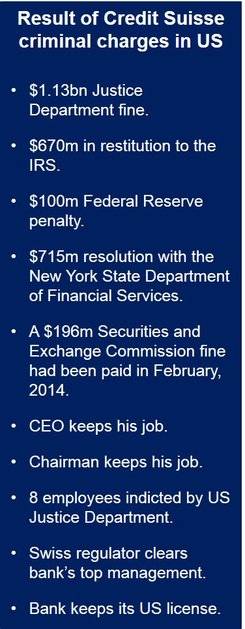
Credit Suisse helped tax cheats and is fined $2.6 billion in the US after pleading guilty. According to the US Justice Department, the Swiss bank is the largest financial institution to plead guilty to criminal charges in over two decades.
In 1995, Daiwa Bank pleaded guilty to concealing a $1.1 billion loss from US regulators. The Japanese bank sold its US operations three months later. This fine far exceeds the $780 million one paid by UBS in 2009 for helping Americans dodge taxes.
According to Eric Holder, US Attorney General, after an investigation that lasted years, US authorities discovered that Credit Suisse and its subsidiaries:
- Engaged in an extensive and wide-ranging conspiracy to help Americans evade paying taxes.
- Were active in helping account holders deceive the Internal Revenue Service (IRS) by hiding income and assets in illegal, undeclared bank accounts.
- Helped individual clients open offshore accounts in the names of fake entities and foundations.
- Were not only aware of this illegal, cross-border banking activity, but also deliberately aided and abetted it.
- Literally hundreds of Credit Suisse workers, including managers, colluded with American tax cheats so that they could dodge US taxes.
Credit Suisse, however, has not been made to hand over the names of its US clients whose accounts may have been used for evading taxes. According to the bank, it is against Swiss law to do so.
Credit Suisse Group AG is based in Zurich, Switzerland, and employs about 46,000 workers globally.
Credit Suisse “deeply regrets” past misconduct
Brady Dougan, an American who has been Chief Executive Office of Credit Suisse since 2007, said:
“We deeply regret the past misconduct that led to this settlement. The US cross-border matter represented the most significant and longstanding regulatory and litigation issue for Credit Suisse. Having this matter fully resolved is an important step forward for us.”
Credit Suisse said the agreed fine will reduce its Q2 2014 profits by $1.8 billion (1.6 billion Swiss francs), but it will not lose its banking license in the United States.
Credit Suisse deceived the Department of Justice, the IRS, the Federal Reserve, and the Securities and Exchange Commission, Mr. Holder explained. It used “elaborate lengths” to shield its tax-cheating clients, its own employees and itself from accountability for their criminal activities.
They destroyed bank records, hid transactions involving undeclared accounts by limiting how much clients could withdraw, issued offshore debit and credit cards so funds could be repatriated, and subverted disclosure requirements.
A shamefully inadequate internal inquiry
Mr. Holder said:
“They failed to take even the most basic steps to ensure compliance with tax laws. And when the bank finally began to feel pressure to correct illegal practices and comply with the law – as a result of the Justice Department’s investigation, of which they were notified in 2010 – Credit Suisse failed to retain key documents, allowed evidence to be lost or destroyed, and conducted a shamefully inadequate internal inquiry.”
In a statement, Mr. Holder assured that Credit Suisse has stopped these illegal activities and changed its business operations.
The Swiss bank has also agreed to provide key data that will help the Justice Department in its enforcements efforts, “so the bank can move forward in full compliance with the law.”
CEO’s job secure, for now
It seems Mr. Dougan’s job is secure. Many had expected US regulators to demand his removal, but they didn’t. According to the New York Times, nobody in the company’s board discussed removing Mr. Dougan.
A number of Swiss lawmakers have been calling for the removal of both Mr. Dougan and Urs Rohner, the bank’s chairman.
Senator Christian Levrat, who is also president of the Social Democratic Party of Switzerland said:

“The strategy pursued by Credit Suisse during the last months to resolve the legal dispute in the U.S. obviously has failed, and somebody has to take the responsibility for this failure.”
The US Justice Department indicted eight Credit Suisse employees on charges related to helping Americans evade taxes, two of them have pleaded guilty.
Many will see Mr. Dougan’s continuing as CEO as a sign that even in the US, top bankers are not held accountable for misconduct that occurs in their institutions.
Even in Switzerland, where one might expect authorities to take measures to address the country’s deteriorating reputation, regulators effectively cleared Credit Suisse’s top management of blame. FINMA, the Swiss regulator, said in an enforcement report “FINMA did not find indications that Credit Suisse’s senior management had known of specific misconduct.”
