
A pulsar, a rapidly rotating neutron star, a deep space spinning lighthouse, has disappeared from view because a space-time warp tilted its beams of light away from Earth.
Astronomers managed to measure the space-time warp in the gravity of a binary star (a system of two stars) and determined the mass of the neutron star, just before it disappeared from view.
The international team of scientists, including astronomer Ingrid Stairs, professor of physics and astronomy at the University of British Columbia, measured the masses of the two stars in the J1906 binary pulsar system. The pulsar spins rapidly and emits a lighthouse-like beam of radio waves every 144 seconds.
The star that was studied orbits its companion star in slightly less than four hours.
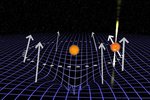
One orbit of pulsar J1906 (right) around its companion (center), with space-time curvature (blue grid). Credit: Joeri van Leeuwen.
Professor Stairs said:
“By precisely tracking the motion of the pulsar, we were able to measure the gravitational interaction between the two highly compact stars with extreme precision. These two stars each weigh more than the Sun, but are still over 100 times closer together than the Earth is to the Sun. The resulting extreme gravity causes many remarkable effects.”
According to general relativity, as they move through the gravitational well of a massive, nearby companion star, neutron stars wobble like a spinning top.
During each orbit, the pulsar travels through a curved space-time, which impacts its spin axis.
Study leader, Joeri van Leeuwen, an astrophysicists who works at the Netherlands Institute for Radio Astronomy, and University of Amsterdam, said:
“Through the effects of the immense mutual gravitational pull, the spin axis of the pulsar has now wobbled so much that the beams no longer hit Earth.”
“The pulsar is now all but invisible to even the largest telescopes on Earth. This is the first time such a young pulsar has disappeared through precession. Fortunately this cosmic spinning top is expected to wobble back into view, but it might take as long as 160 years.”
Scientists have only ever managed to measure the mass of a handful of neutron stars. The one in the J1906 binary system is the youngest. It is about 25,000 light years from Earth.
The study was presented at the American Astronomical Society meeting in Seattle on January 8th, and published in the Astrophysical Journal.
“The Binary Companion of Young, Relativistic Pulsar J1906+0746,” by Joeri van Leeuwen, Laura Kasian, Ingrid H. Stairs et al., Astrophysical Journal, Jan 08, 2015. doi:10.1088/0004-637X/798/2/118.
