

Sabine Lautenschlaeger, a member of the European Central Bank’s (ECB’s) Executive Board, warned that the large scale purchase of sovereign bonds is a bad idea. The ECB’s Executive Board is responsible for implementing monetary policy for the Eurozone, it votes on interest rates, among other things.
She added that the ECB has extremely limited elbow room for additional easing of monetary policy, even though inflation in the Eurozone has fallen into the deflation danger zone.
Ms. Lautenschlaeger a former Bundesbank vice-president, said in a speech on Saturday in Berlin: (translated from German):
“A consideration of the costs and benefits, and the opportunities and risks, of a broad purchase program of government bonds does not give a positive outcome. There are very few shared competencies in fiscal policy. As long as this is the case, the ECB’s purchase of government securities is inevitably linked to a serious incentive problem.”
“For me, given the current situation, the hurdles for further measures are very high, especially for broad purchase programs.”
Lautenschlaeger is ECB President Mario Draghi’s highest-ranking opponent to introducing QE to the Eurozone. Bundesbank President Jens Weidmann is also anti-QE, saying it diverts attention from what really matters – getting governments to make structural adjustments to their economies.

Ms. Lautenschlaeger pointed out that long-term interest rates on Italian and Spanish government bonds are already lower than those from the UK or US. “It is, therefore, questionable whether we should ‘depress’ interest rates for the securities class even further,” she said.
The ECB’s Monetary Policy Committee meets next week.
While acknowledging that creativity in monetary policy should not be discounted, Ms. Lautenschlaeger emphasized that it should not be an “end in itself.” Any further measures to boost inflation and economic growth by the Eurozone’s central bank must be considered carefully, she added.
Interest rates in the Eurozone are virtually at zero. The ECB is getting a purchasing program ready, which may include quantitative easing, i.e. the purchase of government bonds.
If the anemic Eurozone economy continues languishing in quasi-deflation and near-zero GDP growth rates in the first quarter of 2015, ECB Vice-President Vitor Constancio said earlier this week that the central bank may make a decision to move on government bond-purshasing.
Germany is fiercely against quantitative easing.
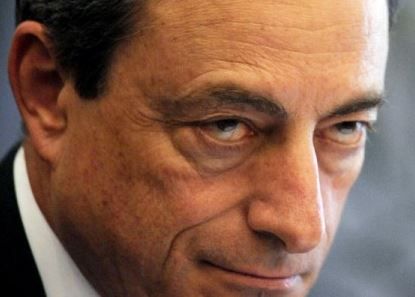
Whether QE does go ahead will depend on how willing Mario Draghi is to beat down powerful opposition from fiscally disciplined Germany.
Government bonds in the Eurozone, unlike those in the UK and US, don’t operate as a benchmark for all further financing operations, Ms. Lautenschlaeger pointed out.
Following the 2007/8 financial crisis, the US Federal Reserve implemented a strategy of credit easing, in order to add money to the system and boost lending.
