

Mario Draghi, President of the European Central Bank (ECB) sent the strongest signal yet on Friday that he is ready to expand the central bank’s asset-purchase programs if inflation continues veering from the ECB’s target of 2% per year.
In a banking conference speech in Frankfurt, Mr. Draghi said the ECB will carry on meeting its responsibility and will do what it has to to lift inflation expectations as fast as possible “as our price stability mandate requires of us.”
Mr. Draghi said:
“If on its current trajectory our policy is not effective enough to achieve this, or further risks to the inflation outlook materialize, we would step up the pressure and broaden even more the channels through which we intervene, by altering accordingly the size, pace and composition of our purchases.”
Analysts took his words as a signal that aggressive easing measures are on the way. The euro fell -0.7% to $1.2458, and Italian government bonds reached a record high.
The Eurozone’s inflation rate is not just ultra-low, it has been threatening to slide into negative numbers. Annual inflation in the currency bloc in October was 0.4%.
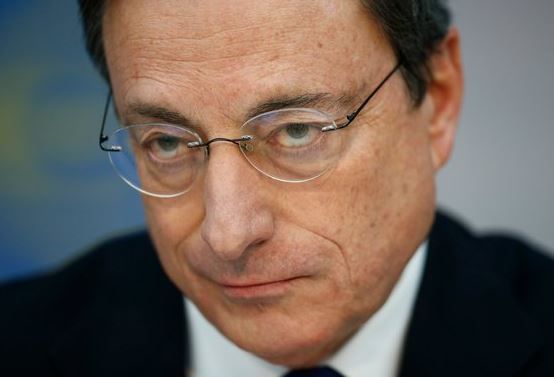
There was a distinct urgency in Mr. Draghi speech today.
The ECB has set interest rates at record lows, and has issued cheap bank loans at 4-year maturities. It has also started programs to buy covered bank bonds and asset-backed securities.
Most economists are betting on a large-scale purchase of government bonds in the first quarter of 2015.
While much of today’s speech was similar to other recent ones, Mr. Draghi sounded much more desperate this time about the need to push up inflation. “It is essential to bring back inflation to target and without delay. Monetary policy can and will do its part to achieve this,” he said.
Mr. Draghi is unlikely to get unanimous approval from the ECB’s Governing Council for other measures. Jens Weidmann, President of the Bundesbank, argues that large-scale sovereign-debt purchases cloud the line between fiscal and monetary. According to people familiar with the inner workings of the ECB, Mr. Weidmann and Mr. Draghi are barely on speaking terms.
Why is ultra-low inflation bad?
Very low inflation and/or deflation can trigger a domino-effect that leads to prolonged economic stagnation, as occurred in Japan for over two decades.
If consumers expect prices to rise they will buy things straight away. If they expect prices not to rise, or maybe even fall, they will delay their purchases, which dampens demand. Lower demand hurts company sales, which in turn leads to lay offs, pay stagnation, and also wage cuts.
In a deflationary environment people’s and company’s debt burden rises. If your income falls each year but your monthly repayments on debts stay the same, they will represent a progressively higher percentage of your income.
