
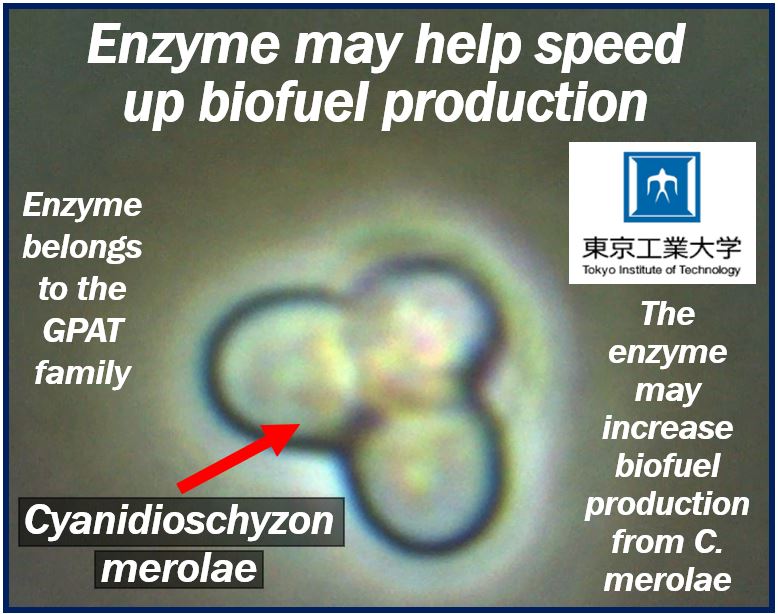
Scientists have identified an enzyme that may help accelerate biofuel production. Scientists at Tokyo Institute of Technology have honed in on an enzyme of the GPAT family. GPAT stands for glycerol-3-phosphate acyltransferase.
An enzyme is a biological catalyst; in other words, it speeds up a biological process.
This enzyme is a promising target for raising biofuel production from Cyanidioschyzon merolae, a red alga.
Algae accumulate large amounts of TAGs under adverse conditions. Nitrogen deprivation for algae, for example, is an adverse condition. The letters TAGs stand for triacylglycerols, i.e., a type of simple lipid or oil.
Alga is a simple plant that is typically aquatic. In other words, it exists in water. Seaweeds, for example, are algae. Algae contain chlorophyll. However, they neither have roots nor stems. They do not they have vascular tissue or leaves either.
Biofuel production – TAGs
Understanding how they store up TAGs is of key interest to people who work in the biotechnology sector. They are interested because it is possible to convert TAGs into biodiesel.
That is why scientists are investigating C. merolae, a unicellular red alga, as a model organism to find out how to improve TAG production.
Sousuke Imamura and colleagues have written about their study and findings in the journal Scientific Reports (citation below). Imamura works at the Laboratory for Chemistry and Life Science, Institute of Innovative Research, Tokyo Institute of Technology (Tokyo Tech).
The research team has shown that GPAT1, an enzyme, plays a key role in TAG accumulation in C. merolae. It plays an important role even under normal growth conditions, i.e., without any need to induce stress.
TAG productivity could grow by a factor of 56
Remarkably, the researchers showed that TAG productivity could increase by over fifty-six times in a C. merolae strain overexpressing GPAT1. This was in comparison to the control strain. Also, there were no negative effects on algal growth.
This study was a follow up on previous research that Imamura and colleagues had carried out. The previous study had suggested that GPAT1 and GPAT2 could be key players in TAG accumulation in C. merolae.
The authors say:
“Our results indicate that the reaction catalyzed by the GPAT1 is a rate-limiting step for TAG synthesis in C. merolae, and would be a potential target for improvement of TAG productivity in microalgae.”
They plan to continue exploring the involvement of both GPAT1 and GAPT2 in TAG accumulation. Identifying transcription factors that control the expression of specific genes of interest will be an important next step.
Commercial biofuel production using microalgae
The researchers add:
“If we can identify such regulators and modify their function, TAG productivity will be further improved because transcription factors affect the expression of a wide range of genes including GPAT1-related genes.”
“This kind of approach based on the fundamental molecular mechanism of TAG synthesis should lead to successful commercial biofuel production using microalgae.”
Citation
“Accelerated triacylglycerol production without growth inhibition by overexpression of a glycerol-3-phosphate acyltransferase in the unicellular red alga Cyanidioschyzon merolae,” Satoshi Fukuda, Eri Hirasawa, Tokiaki Takemura, Sota Takahashi, Kaumeel Chokshi, Imran Pancha, Kan Tanaka, & Sousuke Imamura. Scientific Reports Article number: 12410 (2018) https://doi.org/10.1038/s41598-018-30809-8.
