
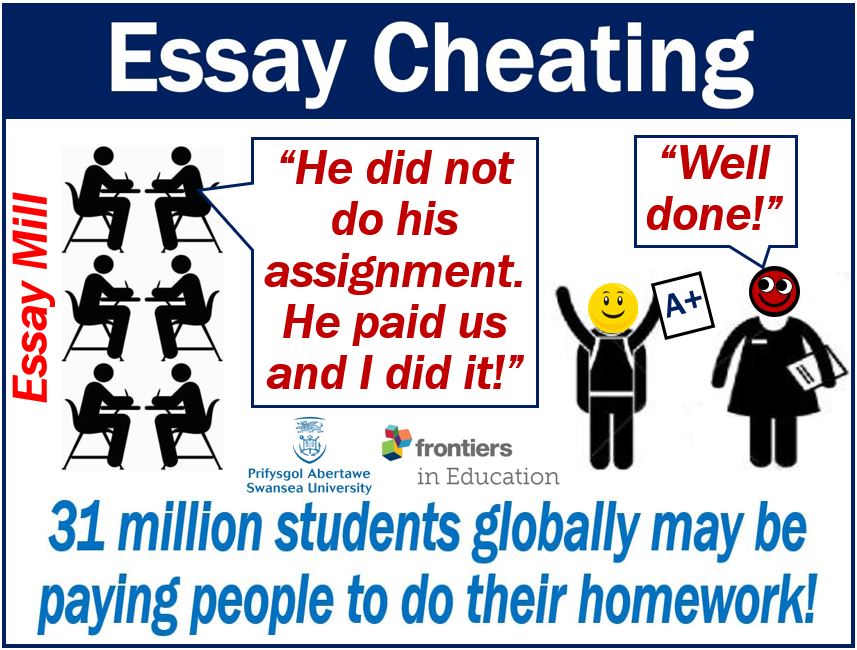
Essay cheating is becoming progressively more common, a researcher at Swansea University in Wales revealed in a breakthrough study. Essay cheating involves people paying somebody else to write their essays. In other words, paying people to do their homework.
Professor Phil Newton wrote about his study and findings in the journal Frontiers in Education (citation below). Prof. Newton, who teaches neuroscience and educational theory, is the Director of Learning and Teaching at Swansea University Medical School.
He gathered and analyzed seventy-one survey samples from sixty-five studies. The studies dated back as far as 1978 and included 54,514 participants.
Essay cheating – hard to detect
Essay mills design their products so that they are hard to detect. They don’t, for example, copy and paste large chunks of text that somebody else has written. Therefore, it is difficult to develop objective measures of contract cheating.
In this new study, the author systematically reviewed findings from previous ‘self-report’ research papers.
The papers had used questionnaires which asked student participants whether they had ever paid essay writers. In other words, whether they had ever paid somebody to do their assignments for them.
Essay mills are businesses that sell original essays on a particular topic. In other words, students pay them so that they can subsequently cheat on their assignments.
Essay cheating – 31 million students
Prof. Newton’s findings showed that up to one in seven recent graduates may have paid an essay writer to do their homework. There may, therefore, be thirty-one million students globally who have engaged in essay cheating.
Across the sample, a historic average of 3.5% of students said they had engaged in essay cheating. However, the percentage of students involved in contract cheating increased considerably over time.
Since 2014, for example, the percentage has been15.7%.
Prof. Newton wrote that according to the studies he reviewed, cheating, in general, appeared to be becoming progressively more common.
Real essay cheating figures probably higher
Prof. Newton believes that the data he gathered and analyzed probably underestimated contract cheating levels. Levels are probably higher because students who pay essay mills are less likely to take part in surveys about cheating. Also, students who cheat and do participate in surveys, are less likely than other students to tell the truth.
In many parts of the world, laws banning essay-mills do not exist. They are not illegal, for example, in the United Kingdom. In the United States, on the other hand, they are banned.
New Zealand is currently developing legislation. Several other countries are also about to introduce new legislation.
Prof. Newton warned:
“The UK risks becoming a country where essay-mills find it easy to do business.”
Regarding his study and findings, Prof. Newton said:
“These findings underscore the need for legislation to tackle essay-mills, alongside improvements in the way students are assessed and awareness-raising of the fundamentals of academic integrity.”
“We need to utilize assessment methods that promote learning and at the same time reduce the likelihood that contract cheating can happen.”
New law proposal
Prof. Newton had carried out a previous study with Professor Michael Draper from the Hillary Rodham Clinton School of Law at Swansea University.
In that study, the researchers concluded that current British laws would be ineffective in tackling essay-mills.
Prof. Newton and Prof. Draper said that the UK needed a new law. There is today an active petition urging the UK government to introduce legislation to address essay cheating.
Professors Newton and Drapers authored a report that QAA published in 2017. QAA stands for the Quality Assurance Agency, an independent body that checks on standards in UK higher education. It also monitors quality.
Teacher training programs do not routinely cover academic integrity, Prof. Newton had found in a previous study. That study also showed that students have a poor understanding of the consequences of engaging in essay cheating.
Citation
Newton PM (2018). ‘How Common Is Commercial Contract Cheating in Higher Education and Is It Increasing? A Systematic Review‘. Front. Educ. 3:67. doi: 10.3389/feduc.2018.00067
