
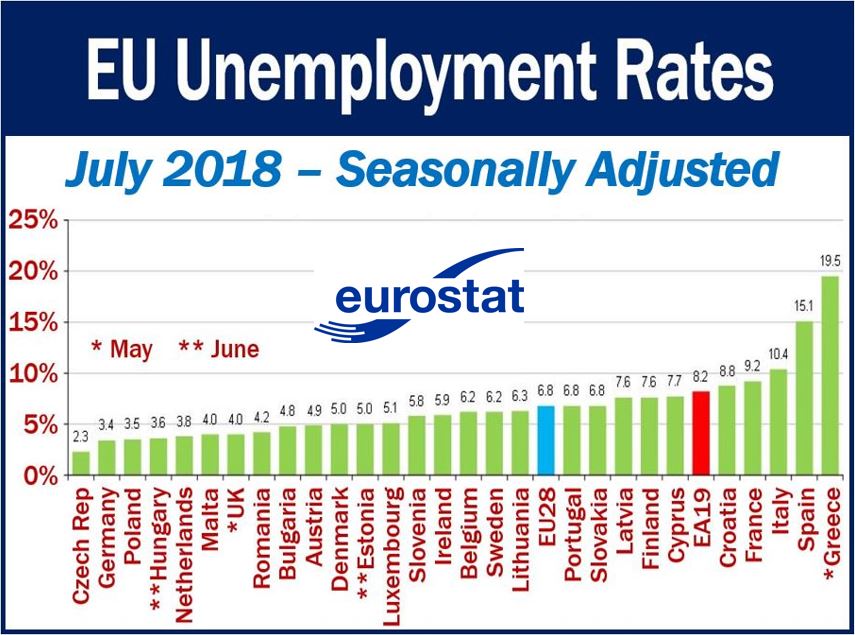
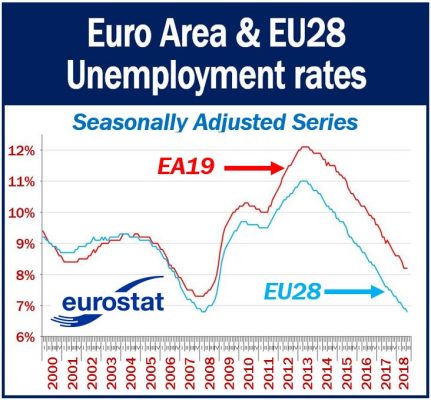
The euro area unemployment rate, seasonally adjusted, stood at 8.2% in July 2018. The EU28 unemployment rate was 6.8% for the same month. In July 2017, the unemployment rates for the euro area and EU28 were 9.1% and 7.6% respectively.
The unemployment rates in the euro area and EU28 for June 2017 were 8.2% and 6.9% respectively.
July’s unemployment rate for the euro area was the lowest since November 2008. The EU28’s unemployment rate in July was the lowest since April 2008.
These figures come from the statistical office of the EU ‘Eurostat.’
Euro Area and EU28 – jobless total
According to Eurostat estimates, 16.823 million men and women in the EU28 were unemployed in July 2018. Of that total, 13.381 million were in the euro area.
Compared with June 2018, there were 82,000 and 73,000 fewer unemployed people in the EU28 and euro area respectively.
Compared with July 2017, there were 1.949 million fewer unemployed people in the EU28. There were 1.368 million fewer unemployed people in the euro area compared with July 2017.
Euro area vs. EU28
The euro area refers to the countries in the EU that use the euro as their national currency. They abandoned their own currency and subsequently adopted the European single currency. We also refer to the euro area as the EA19, because it consists of nineteen Member States.
The EU28 means all the Member States of the European Union. Apart from the nineteen euro area countries, it also includes EU countries that did not adopt the euro.
The United Kingdom and Denmark, for example, are EU countries that did not adopt the euro as their national currency. Therefore, the UK and Denmark are not part of the euro area or EA19. However, they are part of the EU28.
Unemployment in individual Member States
Among the EU Member States, the following three countries posted the lowest unemployment figures:
– Czech Republic 2.3%.
– Germany 3.4%.
– Poland 3.5%.
The following three countries posted the highest unemployment figures:
– Greece 19.5% (May 2018).
– Spain 15.1%.
EU28 unemployment compared with July 2017
Unemployment declined in all Member States in July 2018 compared with July 2017.
The following countries posted the largest decrease:
– Cyprus 7.7% from 10.7%.
– Greece 19.5% from 21.7%.
– Portugal 6.8% from 8.9%.
– Croatia 8.8% from 10.9%.
The jobless rate in the United States in July 2018 was 3.9%. In June 2018 it stood at 4%, and in July 2017 it was 4.3%.
EU28 unemployment – under 25s
Unemployment among people aged less than 25 years in the EU was 3.325 million in July 2018. Of that total, 2.365 million were in the euro area. We call this type of unemployment ‘youth unemployment.’
Youth unemployment declined by 466,000 in the EU28 compared with July 2017. It also fell in the euro area during the same period, but by just 294,000.
In the EU28, the youth unemployment rate in July stood at 14.8%, while in the euro area it was 16.6%. In July 2017, the rates were 16.8% and 18.7% respectively.
The following countries registered the lowest youth unemployment rates:
– Germany 6.1%.
– Malta 6.3%.
– Czech Republic 6.6%.
The following Member States registered the highest youth unemployment rates:
– Greece 39.7% (May 2018).
– Spain 33.4%.
– Italy 30.8%.
