
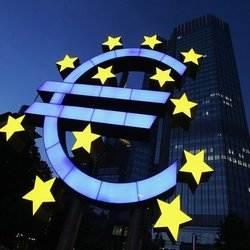
Is a European Central Bank policy change about to occur as the Eurozone faces persistent, very-low inflation? ECB (European Central Bank) president Mario Draghi gave a hint on Thursday that this is something he and his team are considering.
On Thursday’s meeting held in Brussels, the ECB’s Governing Council voted to keep interest rates unchanged at 0.25% on the main refinancing operations, 0.75 on the marginal lending facility, and 0.00 on the deposit facility.
The ECB is not resigned to low inflation, Draghi emphasized, which at 0.7% per year in April is far below the central bank’s target of 2%. However, April’s figure was higher than March’s 5%.
Very low inflation can lead to deflation
Persistently low inflation can tip an economy into deflation – when prices fall. Falling prices are bad for an economy, consumers and businesses postpone their purchases because they know there are better deals if they wait. If consumers buy less, businesses’ sales fall and the economy slows down, eventually unemployment rises and wages fall.
Across the Eurozone there is persistently low inflation, and even some cases of price falls. Calls for the ECB to cut rates and implement some kind of stimulus program are growing.
Even some northern European countries are reporting falling prices, including Sweden which saw prices fall by -4% in March. In one European country which is outside the EU, Switzerland, there is a decline in prices. Spain, Portugal, Cyprus, Greece, Bulgaria, Slovakia and Croatia have also reported deflation.
However, recently the European Union has published promising economic data, suggesting that perhaps the urgency to act has been reduced.
The ECB will publish some reviewed forecasts in June, Mr. Draghi said on Thursday. He added that the Governing Council, which includes 24 members, is concerned about the projected path of inflation and “is not resigned to have too low inflation for too long a time.”
Draghi also added that next time the ECB will be “comfortable with acting,” i.e. there is a good chance of a European Central bank policy change in June.
ECB will act if required
Mr. Draghi said in a new conference:
“Looking ahead, we will monitor economic developments and money markets very closely. We will maintain a high degree of monetary accommodation and act swiftly, if required, with further monetary policy easing.”
“The Governing Council is unanimous in its commitment to using also unconventional instruments within its mandate in order to cope effectively with risks of a too prolonged period of low inflation. Further information and analysis concerning the outlook for inflation and the availability of bank loans to the private sector will be available in early June.”
Drahi reiterated that the ECB expects its key interest rates to stay at their present or lower levels for a long time.
Soon after Mr. Draghi’s comments were published the euro dropped to below $1.39, going below $1.40 for the first time in over two-and-a-half years.
ECB monetary analysis
March 2014 saw continued subdued underlying growth in M3 (broad money). M3 annual growth moderated to 1.1% in March, compared to 1.3% in February. Although remaining robust, the growth of the narrow monetary aggregate M1 fell to 5% in March, after growing by 6.2% in February.
The main factor supporting annual M3 growth has been the rise in the MFI net external asset position, partly reflecting continued interest of overseas investors in euro assets.
Draghi says the ECB forecasts that the general government deficit in the Eurozone will fall further to 2.5% of GDP (gross domestic product) in 2014 and then 2.3 in 2015, compared to 3% in 2013.
The government debt-to-GDP ratio is predicted to stabilize at 96% this year, and then to fall to 95.4% in 2015.
