
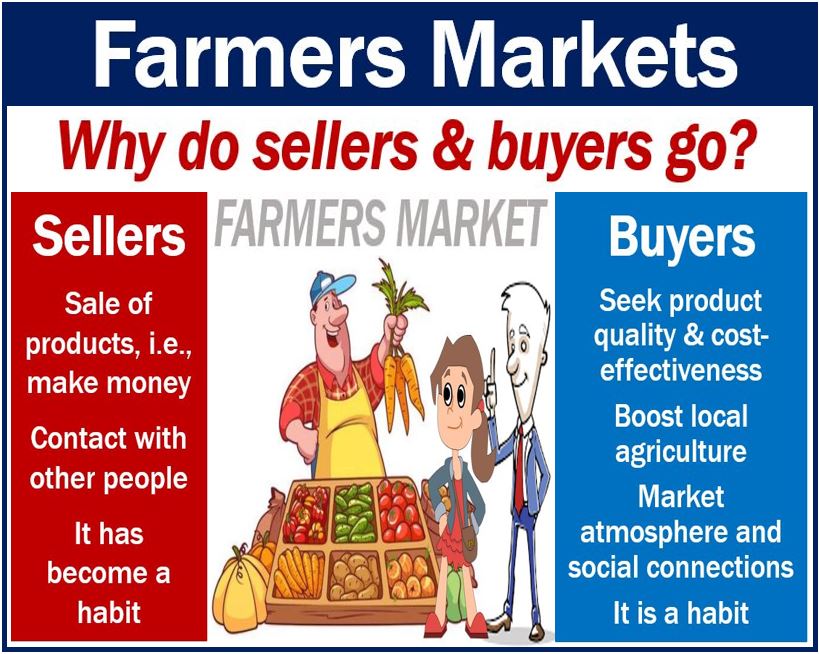
Farmers markets boost the economies of cities and towns, a new study has found. The researchers, from the Faculty of Economics and Business, UPV/EHU-University of the Basque Country, in Donostia-San Sebastian, carried out a study on farmers markets. Unfortunately, farmers markets are on the decline.
Donostia (Basque) or San Sebastián (Spanish) is a coastal city in the Basque Autonomous Community, northern Spain.
Spelling
We can write the term with or without an apostrophe. In other words, we can write either ‘farmer’s market’ or ‘farmers market.’
If you are writing an article, however, you must be consistent. If you start without the apostrophe, continue without it.
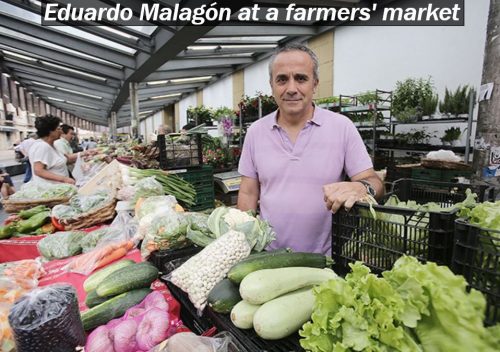
Ten farmers markets
In this study, the researchers gathered and analyzed data on ten farmers markets in Gipuzkoa, in the Basque country. They concluded that the markets delivered an economic boost worth €76.5 million. This translates into 0.35% of Gipuzkoa’s GDP.
GDP stands for Gross Domestic Product. GDP represents all the goods and services that a town, region, or country produces over a specific period.
Mirene Begiristain and colleagues wrote about their study and findings in the Journal of Rural Studies (citation below). Prof. Begiristain is a member of the UPV/EHU’s research group.
Prof. Begiristain said:
“Farmers’ markets are not places that merely connect the rural environment with the town or city, they are also centers that provide a boost in each municipality and district.”
“If we want to keep these markets alive in the future, we have to enhance the importance given to them and which should be given to them in the food system of municipalities and cities, since the proliferation of other forms of trading, among other things, have led to the decline of markets.”
Study included weekly and daily markets
The researchers studied ten daily and weekly farmers markets in ten Gipuzkoa municipalities. They reflected the diverse reality that these markets are currently experiencing.
The authors studied the following farmers markets: Bergara, Tolosa, Arrasate-Mondragon, Azpeitia, Eibar, Ordizia, Zumarraga, Zarautz, La Bretxa, and the itinerant market of Donostia-San Sebastian.
Study participants were people who went to these markets daily or weekly to buy and sell goods. In other words, the authors studied both consumers and sellers. The researchers asked them to complete a questionnaire.
Regarding the data from the questionnaire, co-author, Eduardo Malagón, a UPV/EHU researcher, said:
“The 26,000 citizens who go to these markets every week in Gipuzkoa spend an average of 19.5 euros a day.”
“What is more, the economic impact of markets is not restricted to sales alone. In many municipalities, markets are a space for providing a commercial and social boost, and on market days the shops and bars in the surrounding areas also reap significant economic benefits.”
“(Bearing these two pieces of data in mind) we have calculated the annual sales, and we can say that the total economic impact is 76.5 million euros (0.35% of GDP).”
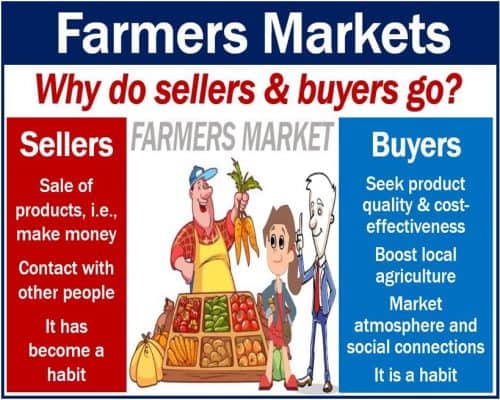
Farmers markets – what motivates people?
The researchers also identified and classified what motivated people to buy and sell goods in the markets.
Among the producers or sellers, the following were strong motivators:
– The sale of products, which the researchers subsequently classed as an economic motivation.
– Contact with other people. This, they classed as a motivation of a social nature.
– Going to the market was a habit. It was, therefore, a motivation of a cultural nature.
These were the main reasons for consumers to go to the farmers markets:
– Individual reasons – they sought product quality. They were also seeking cost-effectiveness.
– Collective reasons – to boost local agriculture and local produce.
– Social reasons – they liked the market atmosphere as well as the social connections.
– Cultural reasons – going to market had become a habit.
Co-author Aintzira Oñederra, a UPV/EHU researcher, said:
“There is no governance model for regulating markets, and knowledge of the actual, specific situation of markets would help to specify the priorities and actions to be developed with a view to reactivating them within the marketing strategy.”
“We continue to believe that it is important for the various players to consider the economic and social impact of these markets so that they can become a meeting point for the buying and selling of everyday produce, and not a space for the occasional purchase of produce.”
Citation
“Who is feeding embeddedness in farmers’ markets? A cluster study of farmers’ markets in Gipuzkoa,” Aintzira Oñederra-Aramendi, Mirene Begiristain-Zubillaga, and EduardoMalagón-Zaldua. Journal of Rural Studies, Volume 61, July 2018, Pages 22-33. https://doi.org/10.1016/j.jrurstud.2018.05.008.
