
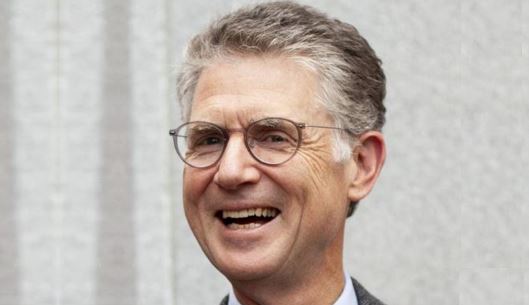
Professor Peter Fisher, a former BlackRock senior executive, warns that we will have another financial crisis. He does not think it will be the same as the last one. The last one, the ‘Global Financial Crisis,’ occurred ten years ago. You would expect that its causes and effects would no longer be with us, but they still are, says Prof. Fisher.
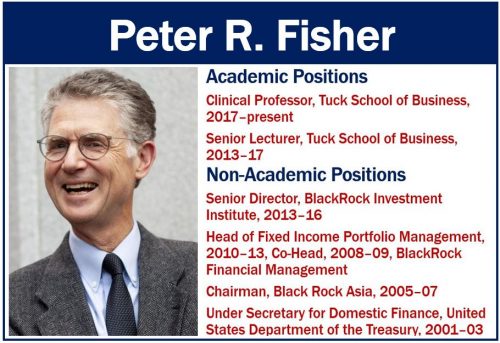
Fisher is a Clinical Professor at the Tuck School of Business, the graduate business school of Dartmouth College in Hanover, New Hampshire. Prof. Fisher teaches The Arrhythmia of Finance. He is also a former Fed and US Treasury official.
Prof. Fisher says that the last global financial crisis happened because money was ‘free’ for too long, and then it dried up. From 2003 to 2006, the Fed held interest rates low for far too long. They then raised them too slowly. This caused credit to grow too rapidly.
The Fed then eased policy too slowly. By the end of 2007, when the Fed started easing, the US was already in recession. “This is the usual mistake the Fed makes,” said Prof. Fisher.
The 2007 crisis was a Global Financial Crisis – it affected countries in North America, Europe, Asia, and other parts of the world.
How did the Fed handle the crisis?
After mortgage credit had grown too rapidly in the run-up to the financial crisis, the Fed was faced with a classic run on the banking system. This occurs when savers and investors become risk-averse and seek to be liquid. In other words, they want cash.
However, a bank run cannot resolve itself in one day – we cannot all withdraw our money the same day. The same applies to stocks and bonds – we cannot all sell them at the same time.
The whole financial system relies on liquidity illusion. As soon as the Fed realized what was happening, they acted promptly and effectively, Prof. Fisher believes. They flooded the banking system with liquidity in the form of the Fed’s own liabilities.
Were bank bailouts a good or bad thing?
According to Prof. Fisher, bailouts were both good and bad. They were bad because the banking executives and shareholders did not have to be bailed out.
However, it was good to liquefy the banking system. If it had not happened, depositors would have woken up to find that their money had gone.
We have not fully recovered
Even though the US economy has grown more strongly over the past two years, we still have not recovered the output that we lost. In other words, we have not recovered the level of GDP that we would have had if there had been no financial crisis.
We are also operating at extremely high levels of debt relative to income. The ratio is not as bad as it was in 2007. However, our levels of debt relative to income are historically high.
What concerns Prof. Fisher today
The inequality of both wealth and income concerns Prof. Fisher. It is both a problem of the wealthy becoming wealthier and the poor becoming poorer.
Prof. Fisher said:
“The Fed’s pursuit of quantitative easing after 2010 specifically sought to create a wealth effect of driving up the value of houses, stocks, and bonds in order to stimulate consumption and strengthen the economy. This is not part of the Fed’s mandate. Making rich people richer is not what monetary policy is supposed to be about.”
He is also concerned about the relatively high levels of corporate and household indebtedness. It will make it more difficult for the economy to recover from the next financial crisis or recession.
Regarding debt, Prof. Fisher said:
“How much debt is the right amount of debt? That is a very hard question to answer. We want to borrow enough from our future so that we can live up to our productive potential.”
“But we don’t want to borrow more from the future than we can pay back without either the stabilizing consequences or the depressing consequences of too heavy a debt burden.”
Will there be another financial crisis?
Prof. Fisher says that ‘unfortunately’ there will be another financial crisis. It may not be the same as the last one. We will also have another recession, he believes. The technical indicator of a recession is two successive quarters of negative GDP growth.
He believes we will face another ‘bank run,’ but it will probably not look like the last one.
Regarding the important lesson that the financial crisis can teach us, Prof. Fisher said:
“A lesson worth learning over and over again is to ask: Why might I be wrong? This is the important risk-management lesson that many financial firms are trying to internalize.”
“We need to catch ourselves when we think that house prices can keep going up and up or when we think it is OK to lend money to people who cannot pay it back.”
