
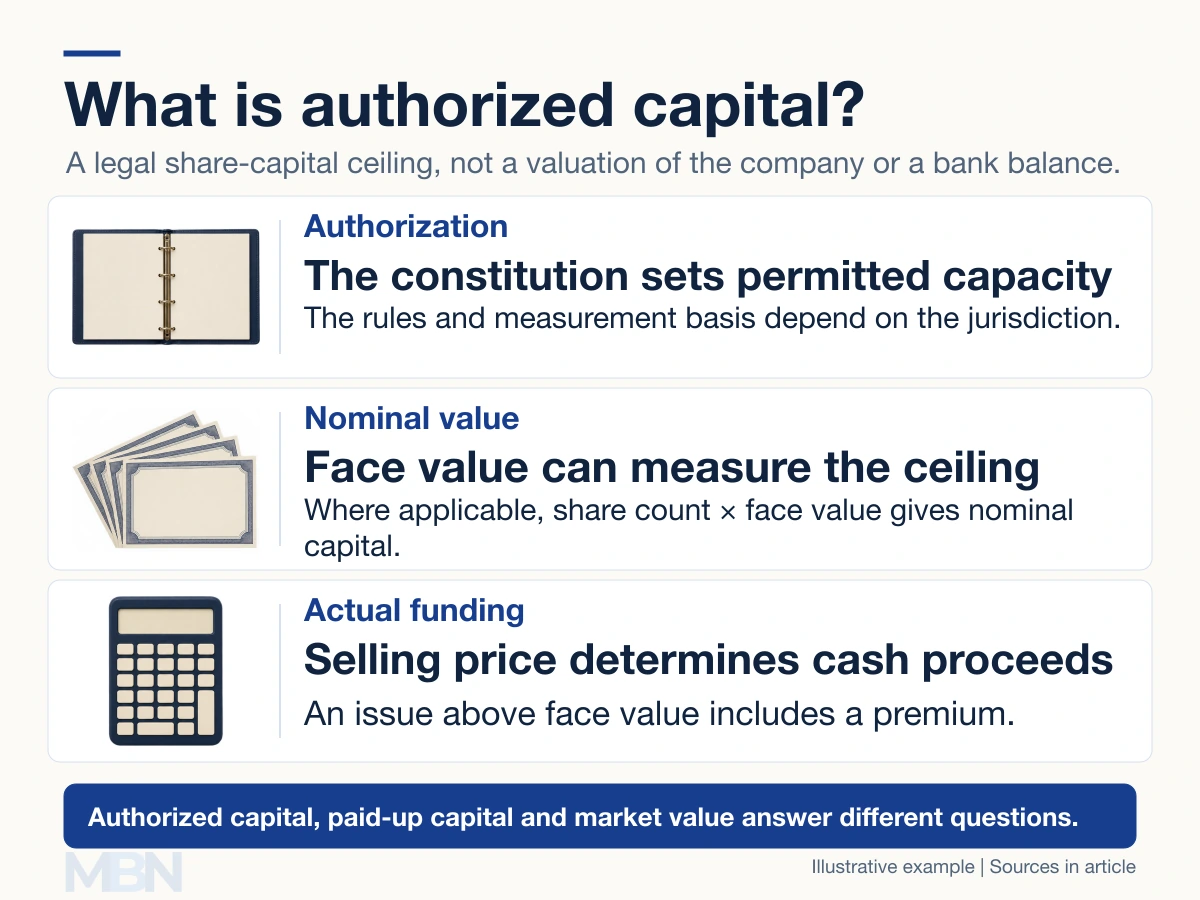
Authorized capital is a company’s permitted share-capital ceiling under the applicable law and its constitution. Where the ceiling is expressed in nominal money terms, it reflects authorized shares at their face values. It is not the company’s market value, its cash balance or the total money shareholders have invested.
The terminology is jurisdiction-specific. India’s Ministry of Corporate Affairs defines authorized capital by reference to the maximum share capital permitted by the memorandum. Its Companies Act 2013 uses authorized capital and nominal capital for that concept.
Nominal value is different from selling price
Face value, also called nominal or par value, is a legal amount attached to a share. It need not equal the price an investor pays. In a nominal-value system, 10,000 authorized shares with a face value of ₹10 represent ₹100,000 of authorized nominal capital.
If 6,000 of those shares have been issued and fully paid at face value, their nominal paid-up capital is ₹60,000. The remaining 4,000 shares represent unused authorization, subject to commitments and other restrictions.
Now suppose the company sells another 2,000 shares for ₹50 each, fully paid in cash. The issue brings in ₹100,000 before costs. Only ₹20,000 is the additional nominal share capital; ₹80,000 is premium over face value.
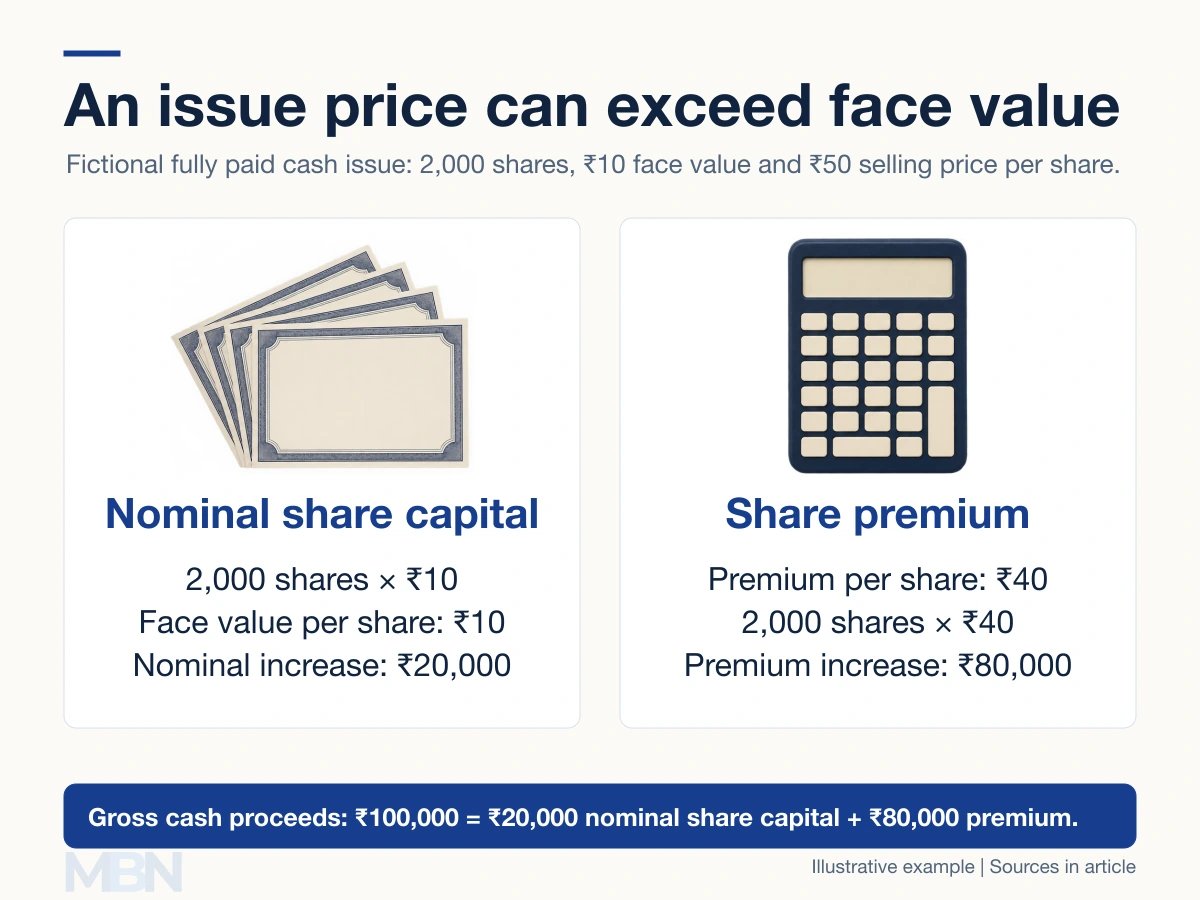
It now has 8,000 issued shares and ₹80,000 of issued nominal capital, leaving 2,000 authorized shares unissued. These fictional figures demonstrate why authorized capital is not a limit on all the money a business can receive.
Issued and paid-up capital are separate measures
Issued capital concerns shares actually issued. Paid-up capital concerns the amount paid or credited as paid on them under the relevant rules. Shares can be partly paid, so issued and paid-up amounts need not match.
HMRC explains the distinction between nominal share capital and a share premium account. Outstanding shares are a share count, excluding company-held treasury shares, rather than a synonym for paid-up money. The authorized-stock article explains those share-count categories.
The UK minimum is not an authorized-capital ceiling
The UK abolished the requirement for authorized share capital from October 1, 2009. Restrictions in a company’s articles can still matter.
Companies House states that a newly incorporated public limited company needs a trading certificate before conducting business or exercising borrowing powers. The sterling route requires at least £50,000 of allotted nominal share capital; its guidance also describes a €57,100 route.
For a public company, each allotted share generally must be paid at least one-quarter of its nominal value, plus the full premium. This is different from having £50,000 of unused authorization or necessarily paying the whole nominal amount immediately.
Public limited company status permits public share offers but does not itself mean the shares are exchange-listed. Exchange admission requirements are a further, separate question.
Changing the ceiling
Where an authorized ceiling applies, changing it requires the procedures set by the governing law and constitution. Increasing authorization does not itself issue shares, raise money or change existing ownership percentages. An actual issue is a separate transaction.
Last checked and updated on November 4, 2026 by the MBN editorial team.