
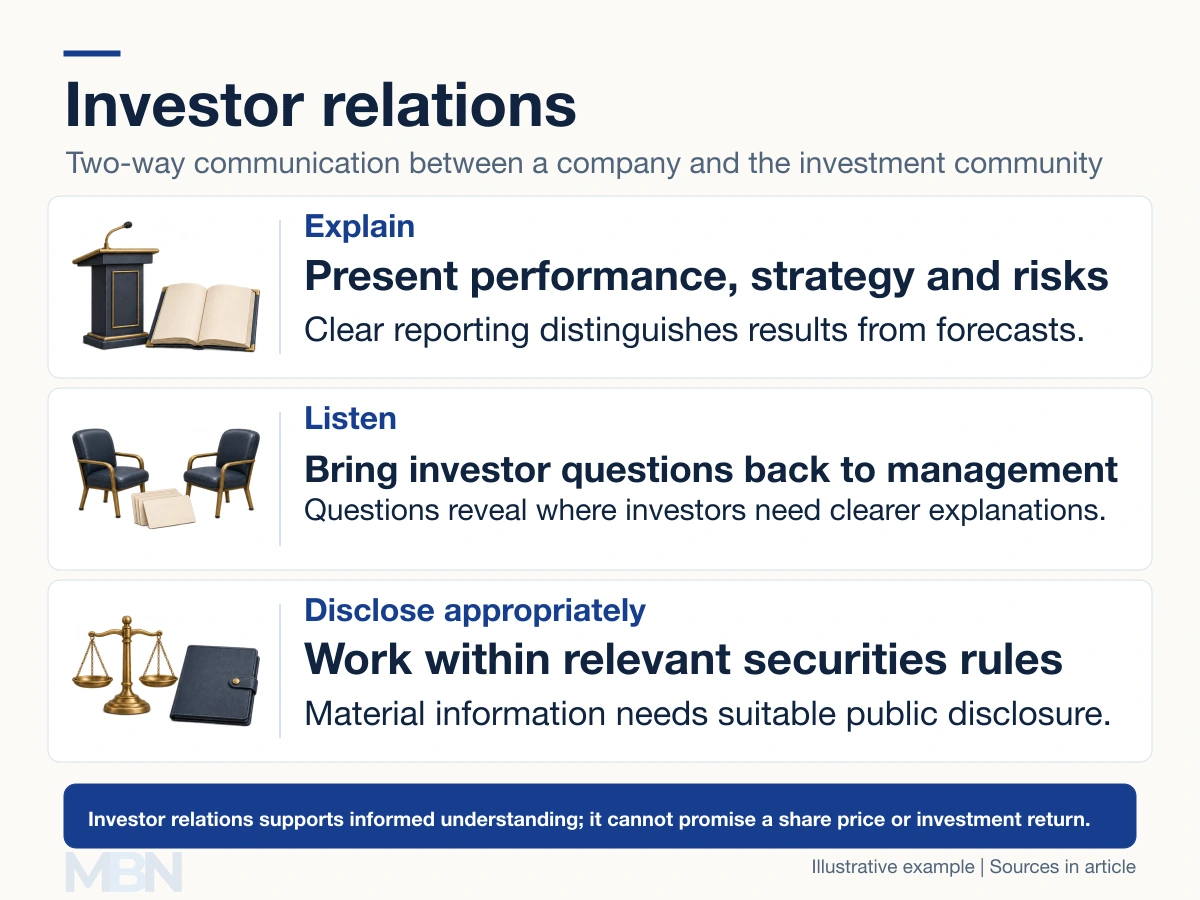
Investor relations, or IR, manages communication between a company and the investment community. It explains performance, strategy, governance and risks while bringing investor questions and feedback to management.
The audience can include shareholders, prospective investors, analysts and debt investors. Listed companies have prominent IR functions, but communication with capital providers can also matter before an initial public offering or in a privately owned business.
A role combining finance and communication
NIRI describes IR as a strategic management responsibility combining financial, communication and securities-law knowledge. It is broader than publicity aimed at generating favourable attention.
An IR team may coordinate earnings materials, annual reports, presentations, webcasts, investor meetings and the company’s investor website. Responsibilities and reporting lines vary; a universal requirement to report to the treasurer or chief financial officer would be misleading.
IR works with finance, legal, company secretarial and communications teams. Management and the board retain their respective responsibilities. Clear communication cannot replace accurate accounts, sound governance or proper legal disclosure.
Making the financial story understandable
Revenue, profit and cash flow measure different things. In a hypothetical year, a company reports $8 million of net profit while customer receivables increase by $10 million. If every other cash-flow adjustment is zero, operating cash flow is −$2 million.
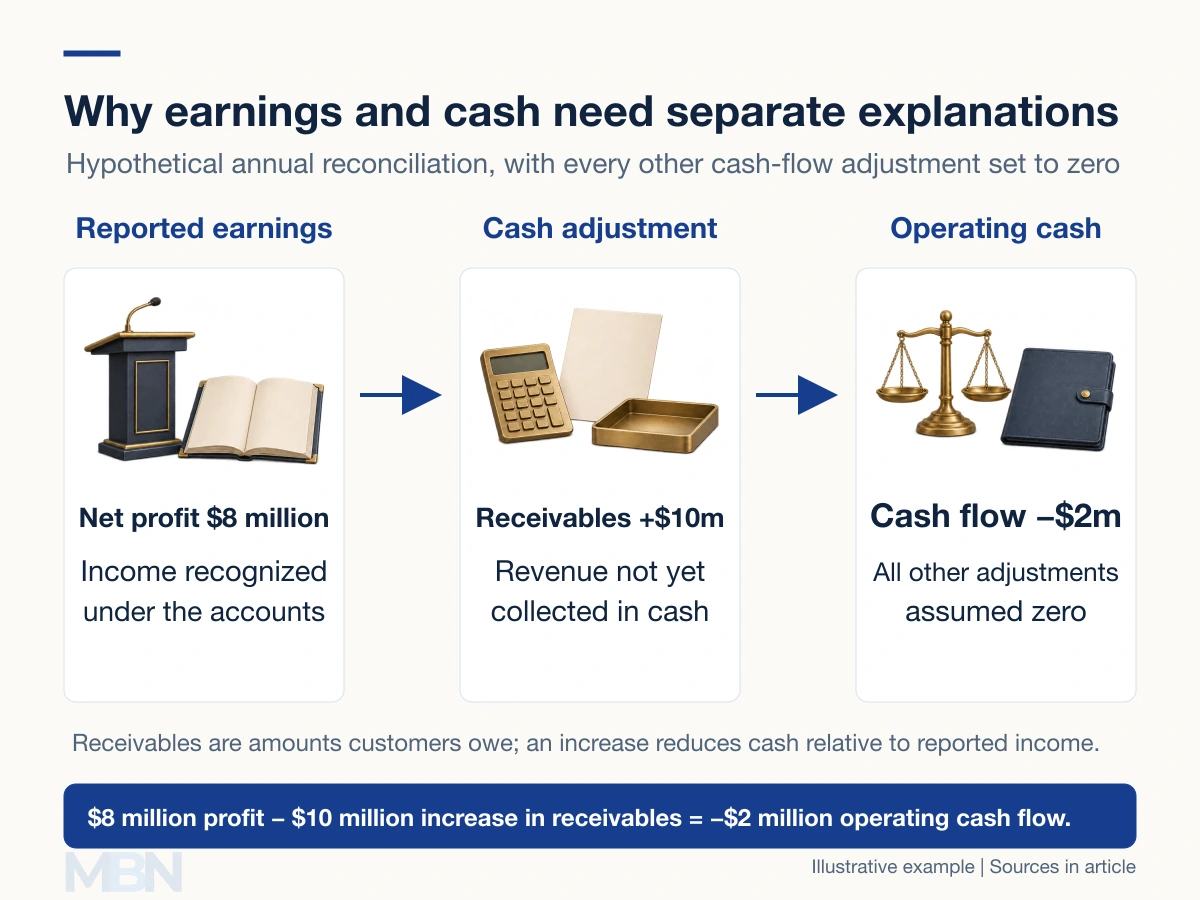
That difference is not automatically evidence of wrongdoing or business failure. Receivables record amounts owed by customers; the explanation needs the timing, collectability and other relevant facts. The SEC’s financial-statements guide explains why profit and cash flow differ.
IR materials should distinguish reported results, management forecasts and analyst estimates. Adjusted measures also need clear definitions. For relevant US disclosures, SEC non-GAAP guidance addresses comparison with GAAP measures, prominence and reconciliation. GAAP means generally accepted accounting principles.
Fair disclosure has a specific scope
US Regulation FD addresses certain selective disclosures of material non-public information by covered issuers or people acting on their behalf to specified recipients. Material information is information important to a reasonable investment decision.
Under the SEC’s adopting release, an intentional covered disclosure requires simultaneous public disclosure. A non-intentional covered disclosure requires prompt public disclosure. Definitions, exceptions and issuer coverage matter; the rule is not a requirement to tell every person every piece of company data at exactly the same instant.
The SEC’s interpretations discuss public meetings and other disclosure channels. A private conversation with an analyst is not a substitute for appropriate public disclosure. Other jurisdictions have their own market-abuse and disclosure rules.
Listening without promising outcomes
Investors may ask about capital allocation, competitive pressure, cash generation or governance. IR can explain disclosed information and relay concerns, while avoiding unsupported assurances and inappropriate sharing of confidential information.
A company may decide that it cannot answer a question publicly at that point. That is different from inventing a reassuring explanation or selectively confirming unpublished results.
IR and public relations
Public relations addresses a wider set of audiences and reputation issues. IR concentrates on capital-market understanding and the information investors use. The functions overlap, but neither guarantees fair valuation or a rising share price.
Share prices reflect expectations and many changing influences. Attributing a historical price movement to one rumour without evidence can mislead. A useful explanation makes the facts, assumptions and limits clear rather than treating market confidence as something IR can control.
Last checked and updated on November 11, 2026 by the MBN editorial team.