
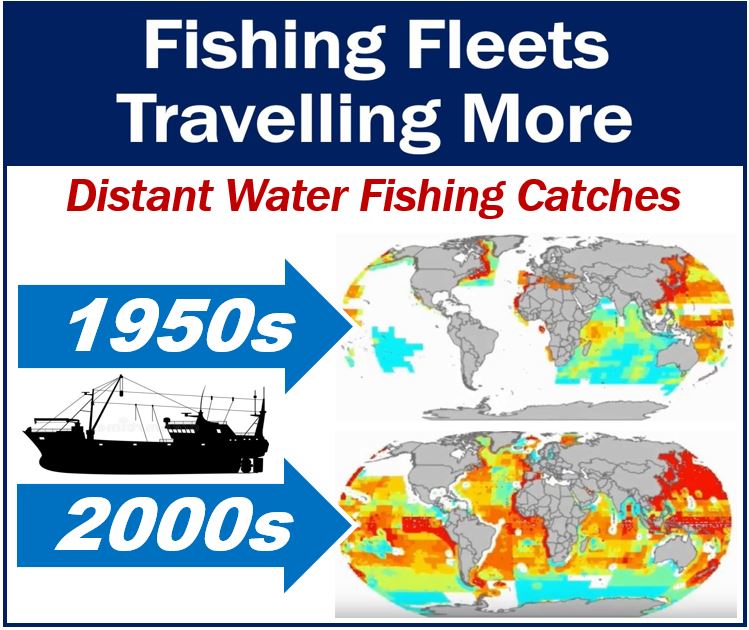
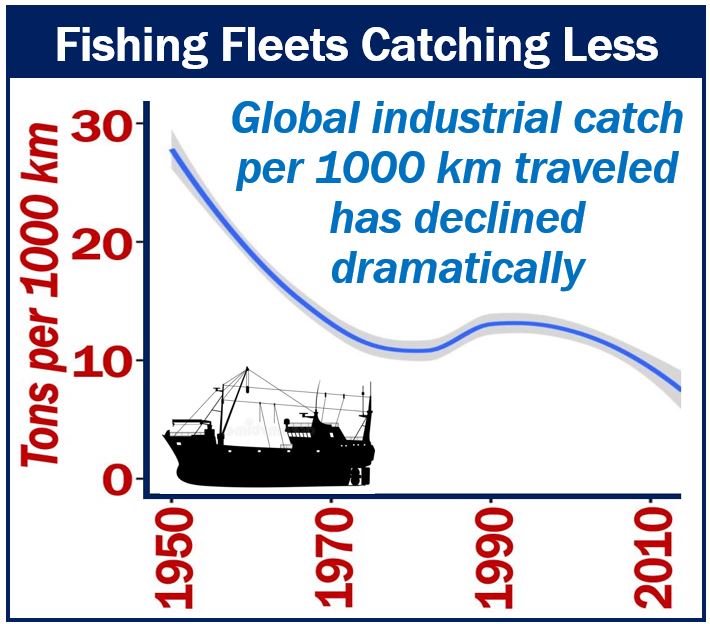
Industrial fishing fleets are traveling twice as far as they did nearly sixty-five years ago. They are also catching fewer tons of fish, say researchers from Australia and Canada. Despite all that traveling, per kilometer traveled, fishing fleets today catch one-third of what they did in the 1950s.
The researchers, from the Universities of Western Australia and British Columbia, wrote about their study in Science Advances (citation below).
Fishing fleets – heavy subsidies
Lead author David Tickler and colleagues mapped the spread and growth of industrial fishing fleets since 1950. They found that a small number of countries that heavily subsidized their fleets dominated global trends.
A subsidy is money that the government gives directly to entities, such as fishing fleets. The government usually subsidizes because it wants to protect an industry.
Over the 65-year period, the total area fished increased from sixty to ninety percent of the world’s oceans.
Tickler, a postgraduate student at the School of Biological Sciences at the University of Western Australia, said:
“While most countries continue to focus their fishing efforts on local waters, Taiwan, South Korea, Spain, and China have aggressively subsidized vessel and fuel costs to encourage their fleets to operate thousands of kilometers from their home ports.”
Fishing fleets catching less
Despite this massive geographical expansion, the catch rates of these fishing fleets have fallen significantly.
These fishing fleets and those of the other twenty largest fishing nations have dropped from 25 to 7 tonnes per 1000 kilometers. This drop was over the sixty-five year period since the 1950s.
Tickler said:
“These findings show that nowadays more fuel is being burned and more time is being spent at sea for every fish caught.”
“These diminishing returns to fishing effort are a worrying indicator of the inability of fisheries to sustainably meet consumer demands and previous catch levels.”
These historical expansions were especially pronounced along the archipelagic waters and coasts of Southeast Asia, the South Asian subcontinent, and South America.
Fishing fleets go nearly everywhere
Co-author Daniel Pauly said:
“Essentially no waters other than those at the polar extremes are presently unfished to some degree. But this continued expansion and concurrent intensification of fishing efforts has only contributed to the depletion of new areas of the ocean.”
Pauly is principal investigator of the Sea Around Us initiative at the University of British Columbia.
Subsidies cause problems
This is further proof that subsidies paid to fishing fleets promote inefficiency. They also encourage unsustainable uses of fisheries resources, the authors wrote.
Co-author Dirk Zeller, head of the Sea Around Us – Indian Ocean at UWA, said:
“The data seem to indicate that we have reached the physical limits of expansion in capture fisheries. Industrial catches peaked in 1996, when the discovery of new stocks was no longer able to keep up with the declines in existing stocks.”
Co-author Jessica Meeuwig offers the following solution:
“We have to accept that for fisheries to continue to support humanity into the future, we are going to have to allow the oceans some space and time to recover from over a century of unfettered industrial fishing.”
Meeuwig heads the UWA’s Marine Futures Lab.
In an Abstract that precedes the main article in the journal, the authors wrote:
“Since 1950, heavily subsidized fleets have increased the total fished area from 60% to more than 90% of the world’s oceans, doubling the average distance traveled from home ports but catching only one-third of the historical amount per kilometer traveled.”
“Catch per unit area has declined by 22% since the mid-1990s, as fleets approach the limits of geographical expansion. Allowing these trends to continue threatens the bioeconomic sustainability of fisheries globally.”
Citation
‘Far from home: Distance patterns of global fishing fleets,’ David Tickler, Jessica J. Meeuwig, Maria-Lourdes Palomares, Daniel Pauly, and Dirk Zeller. Science Advances, 01 Aug 2018: Vol. 4, no. 8, eaar3279. DOI: 10.1126/sciadv.aar3279.
Video – Industrial fishing fleets expansion
This Sea Around Us video explains what has happened to the world’s fishing fleets since the 1950s.
