

Food waste from Canadian restaurants, grocery stores and households cost a total of $31 billion in 2014, up from $27 billion in 2010, according to a study published by Value Chain Management International (VCMI) on Thursday.
The report revealed that food waste is costing the average family in Canada about $86 per month, while between 5% to 11% of restaurants’ profits end up in land fills.
Food waste does not only cost the consumer, but businesses too. Reducing food waste makes good business sense, the authors explained.
Report co-author Dr. Martin V. Gooch said:
“We have to change the attitude and value our food more. We have to value where the food comes from. When an average household is wasting at least an average of $86 of food a month, that’s a lot of money we could put back in our pocket just at a household level.”
Food waste is the cause of enormous financial costs, because it never occurs in isolation. Water, energy, labor and other resources that are utilized when producing and distributing food are also wasted.
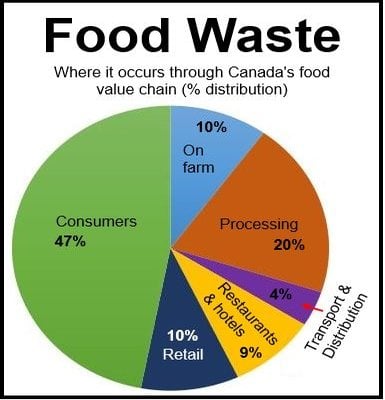
Compared to VCMI’s 2010 assessment, the distribution percentage is relatively unchanged. (Source: Value Chain Management International)
According to the report “For businesses, the total cost of waste occurring along a *value chain can exceed the combined margins of the involved companies.”
* Value chain refers to every activity a company is involved in, from acquiring the raw materials, getting the finished product to the consumer, plus the after sales service – actions that add value.
Consumers and businesses suffer because of food waste
Avoidable food waste can raise the cost of food for consumers by 10% or more. No matter how careful we are at home, we all pay for the waste that occurs before we buy our food.
The grocery business has become highly competitive, all participants are experiencing squeezed margins. Few opportunities exist today to reduce operating costs by 15% to 20% and raise profitability to the equivalent of 5% to 11%. Addressing food waste can cut costs by those amounts, the report claims.
So why are businesses reluctant to change, despite these huge costs and potential benefits? One important obstacle, the authors say, is the adversarial relationship that exists in the food industry.
In the words of one food expert the authors quote:
“Consumers are busy picking off deals, while retailers and suppliers are busy picking off each other. This produces enormous amounts of food waste and is unsustainable.”
The authors put forward approaches that businesses could use to reduce waste and associated resources and improve margins, … and ultimately profits. “The greatest determinant of whether businesses grasp the potentially immense opportunities that undoubtedly exist is the attitudes of individual managers and employees,” they conclude.
