
Generous people are generally happier than their selfish counterparts, a new study reveals. Generosity really does make us happier, even if we are just a tiny bit generous. Individuals who act solely out of self-interest are overall less happy, says an international team of neuroeconomists after carrying out a series of experiments on fifty volunteers.
What many of us have been aware of for several years, others find difficult to appreciate or believe: People who are concerned about their fellow humans’ well-being – generous people – are happier than individuals who focus entirely on their own advancement – selfish people.
The researchers found that even when we just promise to be more generous, something changes in our brains that makes us happier.
In an article published in Nature Communications on 11th July, 2017, titled – A neural link between generosity and happiness’ – the authors, from Switzerland, Germany, and the United States, wrote that most of us get a pleasant feeling when we do something nice for another person. Behavioral economists call this nice feeling a warm glow.
Philippe Tobler and Ernst Fehr, who work at the Department of Economics at the University of Zurich in Switzerland, and colleagues investigated how brain areas communicate to give us this warm glow. They claim that their findings provide insight into the interplay between happiness and altruism.
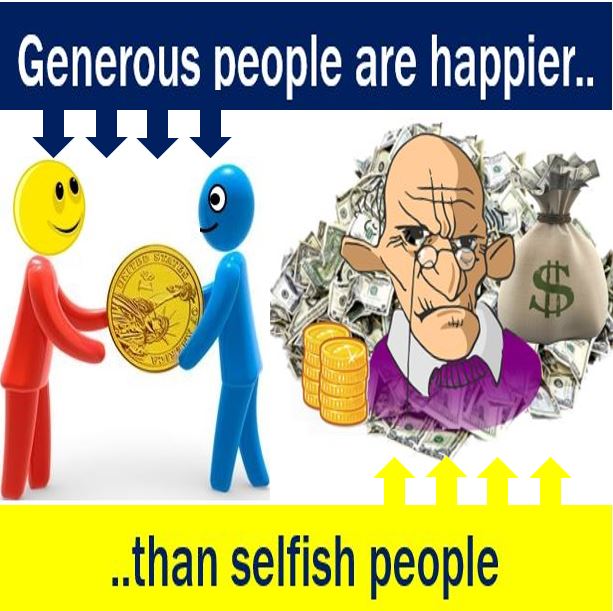 According to the study, generous people are happier than selfish individuals.
Even slightly generous people are happier
In their experiments, the authors found that individuals who behaved generously were happier afterwards compared to those whose behaviors and actions were more selfish.
However, being more generous than just a bit did not appear to boost contentment. In other words, you can feel that warm glow if you are just a bit generous – being very generous does not intensify that sensation; the amount of generosity did not influence the increase in happiness.
Tobler said:
“You don’t need to become a self-sacrificing martyr to feel happier. Just being a little more generous will suffice.”
Before participating in the experiment, some of the study volunteers had verbally committed to behaving more generously to those around them. This group was willing to accept greater costs in order to do nice things for other people.
These participants also claimed they felt happier after their generous behavior (but not beforehand) than the control group. Those in the control group had committed to being generous only to themselves – they had committed to being selfish.
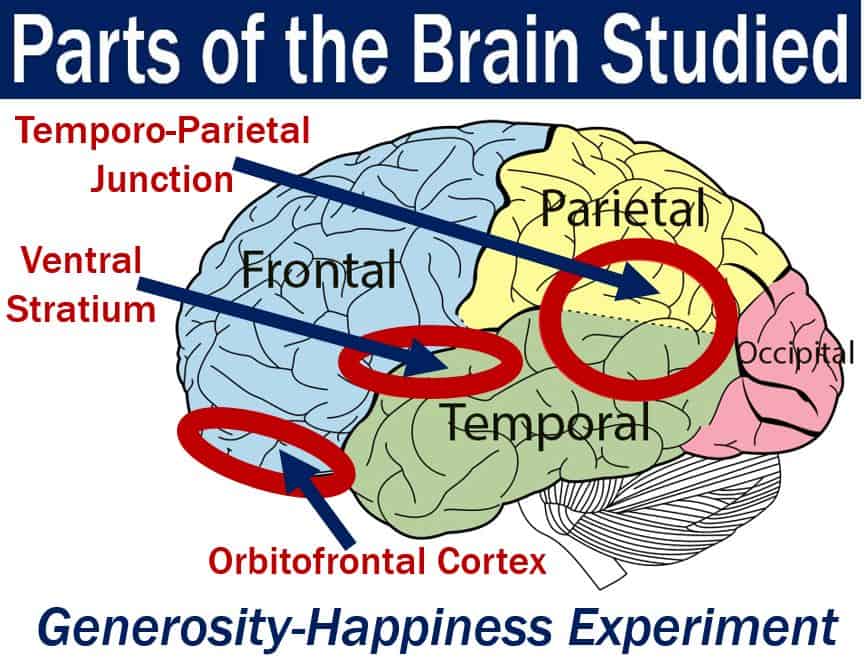 It became compellingly clear during the experiments that when people are generous, or commit to being generous, parts of their brain associated with happiness become more active.
Just the intent can trigger neural changes
While the volunteers were making their decision to become either selfish or generous people, the research team examined activity in three areas of their brains:
1. The Temporo-Parietal Junction – this is where prosocial behavior and generosity are processed.
2. The Ventral Striatum, which is associated with our feelings of happiness.
3. The Orbitofrontal Cortex, where we compare and weigh up the pros and cons during decision-making processes.
These three areas in the brain interacted differently, depending on whether the volunteers had committed to selfishness or generosity.
When the volunteers promised to behave generously, the altruistic area of the brain was activated. There was also more interaction between this area and the area associated with happiness.
Tobler said:
“It is remarkable that intent alone generates a neural change before the action is actually implemented.”
Co-author Soyoung Park, from the Department of Psychology at the University of Lübeck in Germany, said:
“Promising to behave generously could be used as a strategy to reinforce the desired behavior, on the one hand, and to feel happier, on the other.”
“There are still some open questions, such as: Can communication between these brain regions be trained and strengthened? If so, how? And, does the effect last when it is used deliberately, that is, if a person only behaves generously in order to feel happier?”
In an Abstract that preceded the main article in the journal, the authors wrote:
“Generous decisions engage the temporo-parietal junction (TPJ) in the experimental more than in the control group and differentially modulate the connectivity between TPJ and ventral striatum.”
“Importantly, striatal activity during generous decisions is directly related to changes in happiness. These results demonstrate that top–down control of striatal activity plays a fundamental role in linking commitment-induced generosity with happiness.”
Many studies have been carried out to determine whether certain activities or attitudes are linked to greater happiness. In 2014, a team of researchers at San Francisco State University found that a sizable percentage of individuals do not get happier when or after they go shopping, which contradicts the ‘retail therapy’ belief.
#Generosity makes people happier, even if they are only a little generous. This is what #UZH neuroeconomists found. https://t.co/gjZWdfoIIT pic.twitter.com/6o4khu9X4L
— University of Zurich (@uzh_news_en) July 11, 2017
