

Germany is building the first wind farm to use hydropower-integrated wind turbines. By combining hydropower with wind power in a new and unique way, the companies involved hope to create a system that generates electricity continuously and responds rapidly to fluctuations in the energy market.
The collaboration between the German firm Max Boegl Wind AG and GE Renewable Energy plans to connect the four-turbine pilot system to the grid by the end of 2017, and to connect the hydropower plant a year later.
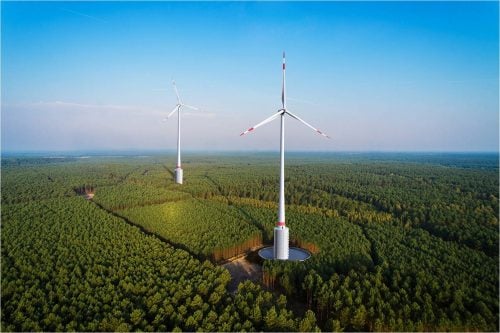 The hydropower-integrated wind turbines that Germany is building in the Swabian-Franconian Forest are unique – they will be very tall and will have water reservoirs inside and underneath them.
Image source: GE Reports
While wind energy is clean and cheap, it is unpredictable – sometimes the wind blows and sometimes it does not. And until there is a breakthrough in battery technology, this presents a problem in ensuring a smooth, continuous flow of energy that can be fed to the grid in a controlled way.
This is where the hydropower part of the new system comes in. When the wind is blowing, the turbines generate electricity and at the same time move water uphill. And once the water is uphill, it can be allowed to run downhill to generate hydropower.
The two sources of power will work alongside each other, ensuring a continuous supply of electricity from the plant.
Tall turbines with integrated water reservoirs
The idea of combining wind power with hydropower is not new. For instance, there is a wind/hydro hybrid plant on El Hierro, one of Spain’s Canary Islands. The flagship project is designed to help the island move to 100 percent renewable electricity.
However, the hydropower-integrated wind turbines that Germany is building in the Swabian-Franconian Forest are unique in that they will be very tall and will have water reservoirs inside them and underneath them.
Each turbine will stand 584 ft (178 m) high (with blade pointing up), and the bottom 131 ft (40 m) of its base will be a water reservoir of 1.6 million gallons (6 million litres) capacity. Plus, the whole turbine will sit inside another larger reservoir holding another 9 million gallons (34 million litres).
The turbines will sit at the top of a hill, overlooking a valley with a man-made lake situated about 600 ft (183 m) below the wind farm. The lake stores the water when it is not being used by the turbines.
Responds immediately to fluctuations in energy market
The way the system works is also unique in how it integrates to the grid.
If you let renewable energy oversupply the grid, it can lead to energy prices going into the negative (effectively paying customers to use electricity – as happened in Germany earlier this year).
In the hydropower-integrated system, allowing the water to run downhill to make power can be timed to occur when the turbines are not busy, and to complement turbine-generated power when electricity prices are high.
Also, as well as allowing the turbines to power the water back uphill, the hydro system itself can use electricity (when prices are low) to send the water back up hill.
The hydroelectric plant will have a capacity of 16 megawatts, while the wind farm on its own will produce 13.6 megawatts.
The engineers say the unique design of the hydropower-integrated wind turbines, plus the accompanying specialized software system, will allow the plant to respond immediately to fluctuations in the German energy market.
Operators will be able to predict maintenance needs, optimize production throughout the day, and control power flow into the grid at any given time.
Should the project prove successful, the plan is for one or two project a year to be built in Germany, helping the country reach its goal of generating at least 45 percent of its energy from renewables by 2030.
