

With ninety-five emerging economies currently participating compared to just 15 in 2005, global renewable energy generation capacity has reached a new record, according to REN21’s Renewables 2014 Global Status Report.
Those 95 nations today make up the majority of the 144 countries’ renewable energy targets and support policies. The growing support from emerging economies contrasts with policy reticence and in some cases retroactive support contractions in the US and parts of Europe.
The Environmental Protection Agency (EPA) released its Clean Power Plan proposal on Monday to reduce carbon emissions from existing power stations in the US, which should revitalize the country’s renewables policy.
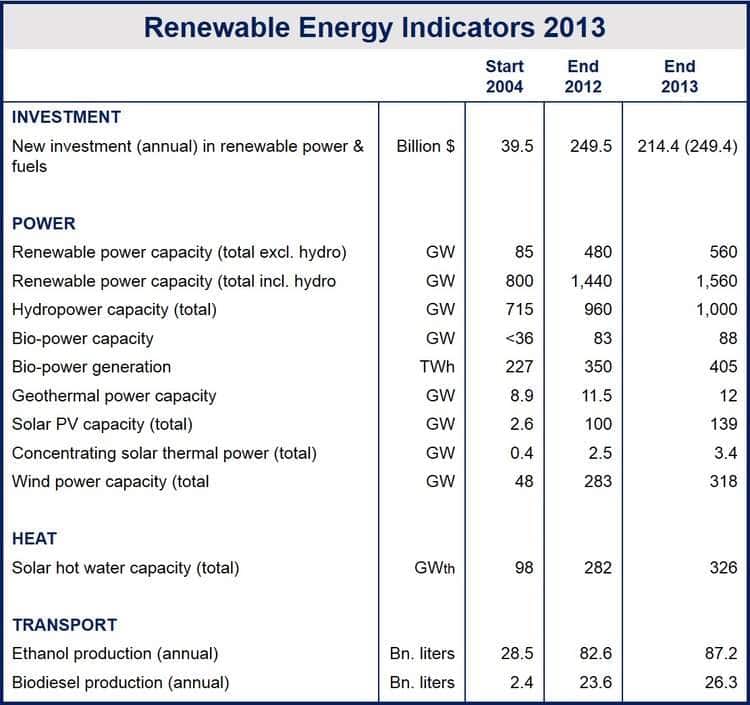
The report was launched at the Sustainable Energy for All in New York, a UN-hosted event. The 2014 report “credits support policies with a central role in driving global renewable energy capacity to a new record level last year – 1,560 gigawatts (GW), up 8.3% from 2012,” say the authors.
Renewable energy spreads across emerging economies
Twenty-two percent of global power production currently comes from renewable sources.
REN21 wrote:
“Markets, manufacturing, and investment expanded further across the developing world, clearly demonstrating that renewables are no longer dependent upon a small handful of countries.”
Last year, approximately 6.5 million people globally worked directly or indirectly in the renewable energy industry.
Below are some of the highlights from the report:
- Over the last twelve months, more than 56% of net additions to power capacity around the world consisted of renewables.
- Hydropower increased by 4% to about 1,000 GW last year, accounting for approximately one-third of additional renewable power capacity. Collectively, other renewables increased by almost 17% to an estimated 560 GW.
- In 2012, 19% of the world’s energy consumption came from renewable sources, and continued growing in 2013. Modern renewables accounted for one-tenth of the total share in 2012, with the remaining 9% coming from biomass (whose share is declining).
- About 4.2% of final energy use came from useful heat energy from modern renewable sources, with 3.8% coming from hydropower and 2% from biomass, geothermal, solar, wind, as well as biofuels.
- More solar PV than wind power capacity was added globally for the first time. Solar PV accounts for approximately one-third of all renewable power capacity added during the year.
- Although investment worldwide in solar PV fell almost 22% compared to 2012, new capacity installations grew by over 32%. The solar PV market registered a record year, adding over 39 GW in 2013 toward a total of about 139 GW. China accounted for almost one third of added global capacity, followed by Japan and the US.
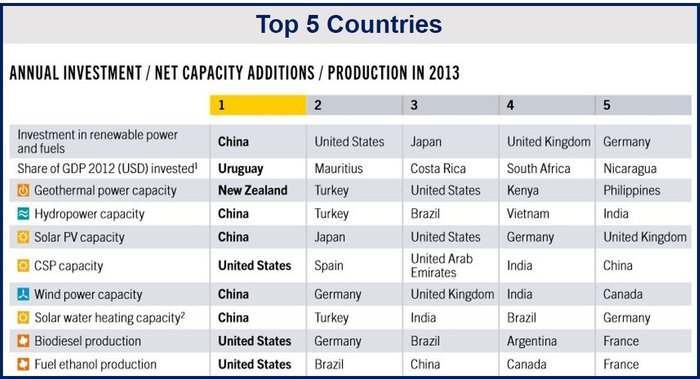
- Germany, Canada, Brazil, the US and China remained the leading countries for total installed renewable power capacity. For the first time, China’s new renewable power capacity overtook new fossil fuel and nuclear capacity.
- For six years running, the European Union registered its sixth successive year in which renewables made up the majority of new electricity generating capacity, reaching a 72% share in 2013. Ten years ago conventional fossil fuel generation represented 80% of new capacity in the region.
- Renewables are achieving rising levels of penetration in several nations. In 2013, wind power represented 33.2% of Denmark’s total electricity demand and 20.9% of Spain’s. In Italy, 7.8% of the country’s electricity demand comes from solar PV. According to the American Wind Energy Association, wind energy costs have declined by 43% during the last four years.
Moving to 100% renewable energy
More and more regions, states and cities are seeking to transition to 100% renewable energy either across their whole economies or in individual sectors.
In Scotland, Djibouti and Tuvalu, authorities have a target of 100% electricity from renewable sources by the end of the decade. Approximately 20 million German’s live in totally renewable energy regions.
- Costa Rica, Mauritius and Uruguay are among the top nations for investment in new renewable power and fuels relative to annual gross domestic product (GDP).
- In one of Brazil’s national auctions wind power was excluded because it was pricing all other sources of power generation out of the market.
- In excess of 35 MW of wind power capacity was added last year, which reached a total of more than 318 GW. However, this was 10 GW less than in 2012, because of a sharp fall in the US market. Offshore wind added 1.6 GW, a record year, most of it in Europe. Global heating and cooling demand is being accounted for by a small but gradually increasing share coming from modern biomass, geothermal and solar sources, which in 2013 amounted to about 10%.
- In 2013, the use of fossil fuel-fired boilers in new buildings was banned in Denmark, which set itself a target of obtaining nearly 40% of total heat supply from renewables by the end of this decade.
- Investment worldwide in renewable power and fuels was $249.4 billion (at least) in 2013; this was less than the record level in 2011.
According to the report, policy mechanisms continue evolving. Feed-in policies in several countries last year shifted towards premium payment in the power sector, and continued being adapted for use in the heating sector.
How to achieve a 100% renewables future
Arthouros Zervos, Chair of REN21:
“Global perceptions of renewable energy have shifted considerably. Over the last 10 years, continuing technology advances and rapid deployment of many renewable energy technologies have demonstrated that the question is no longer whether renewables have a role to play in the provision of energy services, but rather how we can best increase the current pace to achieve a 100% renewables future with full energy access for all.”
“For this to be become reality, current thinking needs to change: continuing the status quo of a patchwork of policies and actions is no longer sufficient. Instead, technology developments, finance models as well as stable and predictable renewable energy policies need to be systematically linked across the public and private sectors in order to support and drive the transition process.”
(Source: REN21)
Christine Lins, Executive Secretary at REN21, says that over the last ten years there has been a worldwide transition to renewables. She adds, however, that a concerted and sustained effort is required to achieve it. “With increasingly ambitious targets and innovative policies, renewables can continue to surpass expectations and create a clean energy future,” Ms. Lins commented.
(Source: REN21)
