
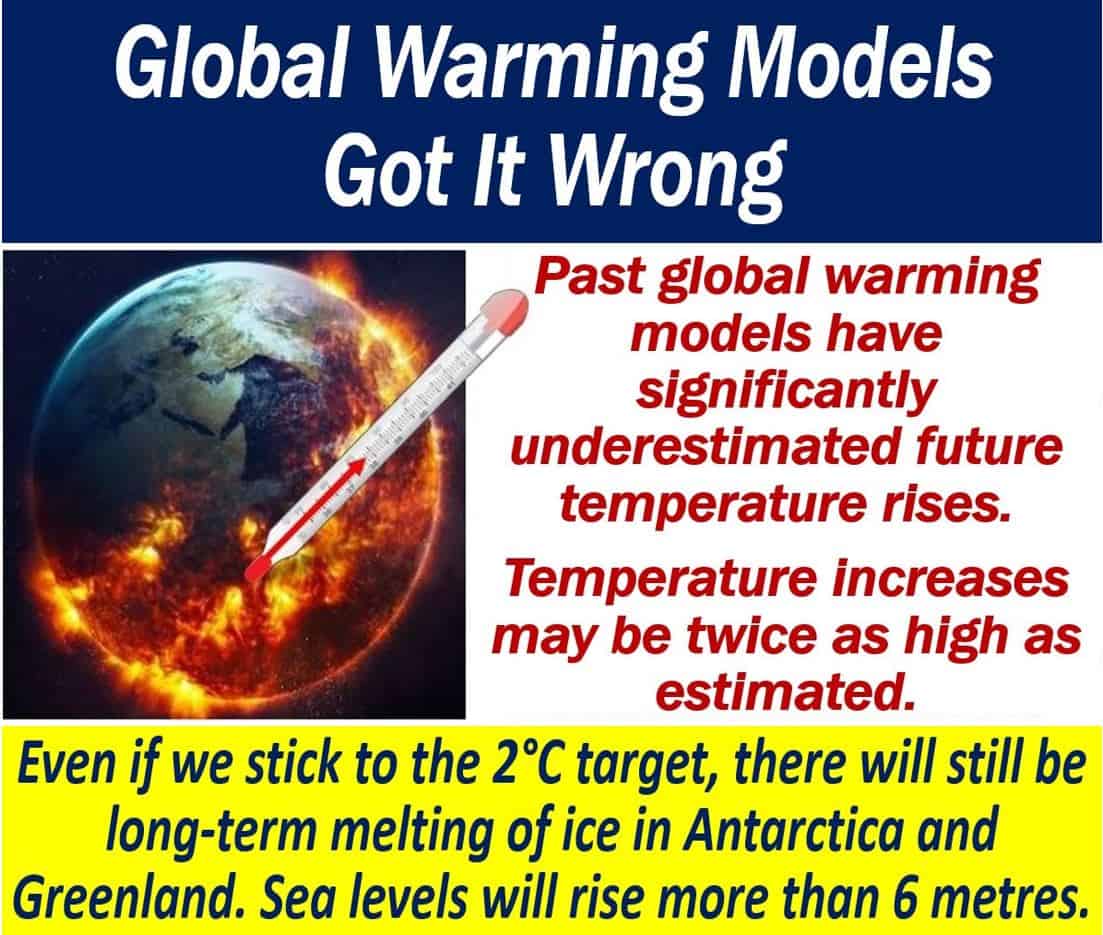
Global warming models may be significantly underestimating future temperature rises, says an international group of scientists. In a new study, scientists have discovered that global warming may be double current and recent forecasts. The new study focused on evidence from past warm periods.
The University of New South Wales informed that the study included scientists from seventeen different countries.
The researchers also calculated that sea levels may rise six meters or even more. This six-meter sea level rise will probably occur regardless of whether we meet the 2°C target.
The study, titled ‘Palaeoclimate constraints on the impact of 2 °C anthropogenic warming and beyond,’ appears in the latest issue of Nature Geosciences.
Global warming refers to the consistent rise in average temperatures of Earth’s oceans and atmosphere. These temperatures are increasing at an accelerating rate.
Global warming models look back
The new global warming models focused on observational evidence from three warm periods in Earth’s past.
They occurred 3.5 million years ago when our planet was 0.5°C to 2°C warmer than temperatures just before the Industrial Revolution. In other words, before the nineteenth century.
The authors revealed how two giant areas of polar ice caps could completely collapse. Also, significant changes to some ecosystems could turn the Sahara Desert green. Additionally, the edges of our tropical forests could become fire-dominated savanna.
A savanna is a grassy plain in subtropical and tropical regions, with very few trees.
Lead author, Prof. Hubertus Fischer, from the University of Bern, Switzerland, said:
“Observations of past warming periods suggest that a number of amplifying mechanisms, which are poorly represented in climate models, increase long-term warming beyond climate model projections.”
“This suggests the carbon budget to avoid 2°C of global warming may be far smaller than estimated, leaving very little margin for error to meet the Paris targets.”
Global warming models – climate zone shift
As global temperatures rise, climate zones and ecosystems will shift toward the poles. They will also shift to higher altitudes. In other words, what is now semi-tropical may become tropical.
In response, permafrost thaw may release extra methane and CO2 into the atmosphere. These are two greenhouse gases, i.e., they exacerbate global warming. CO2 stands for carbon dioxide.
According to past observations, the risk of catastrophic greenhouse gas feedbacks is low if we can limit global warming to 2°C. However, we must consider the additional carbon dioxide coming from permafrost and soils in future emission budgets.
Prof. Fischer explained:
“Accounting for the additional release of CO2 leaves even less room for error or delay as humanity seeks to lower its CO2 emissions and stabilize global climate within reasonable limits.”
Global warming models significantly underestimated
In an Abstract preceding the main article in Nature Geoscience, the authors wrote:
“Comparison of palaeo observations with climate model results suggests that, due to the lack of certain feedback processes, model-based climate projections may underestimate long-term warming in response to future radiative forcing by as much as a factor of two, and thus may also underestimate centennial-to-millennial-scale sea-level rise.”
