

Google informed that it had 345 million requests for link takedowns in 2014, nearly one million each day, which was 550,000,000% more than the 62 requests in 2008. The number of people trying to eliminate pirated content has exploded.
There were 75% more takedown requests in 2014 than in 2013.
Torrent Freak compiled the figures using Google’s weekly transparency reports. Apparently, Google complied with the vast majority of copyright takedown requests.
If a link is deemed not to be infringing or if it had been taken down previously, Google sometimes takes “no action”.
Google said some people and/or companies abused the takedown request service. It gave as an example a British driving school that asked a rival’s homepage be erased from Google search results because it had mentioned the same cities and regions where driving tuition was offered.
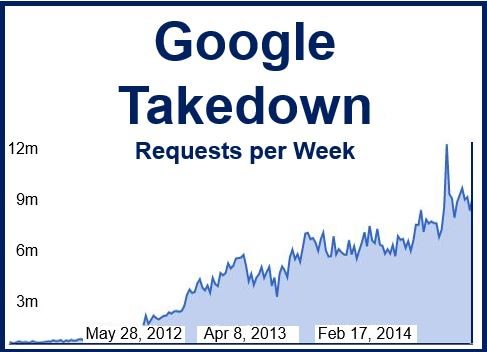
Source: Google Transparency Report.
Another example of a refused request was a US company that asked for a link be removed to a worker’s blog post that criticized how it treated its employees.
Google informed that the most frequently targeted domains were 4shared.com, rapidgator.net and uploaded.net, which were at the end of 5 million takedown requests each.
The largest number of requests last year came from The British Phonographic Industry (BPI), the UK’s music industry trade body, which asked for more than 60 million link takedowns.
According to the search engine giant, people resort to piracy because original versions are either too expensive or too difficult to acquire legally.
Google said in a statement:
“Piracy often arises when consumer demand goes unmet by legitimate supply.”
“Spotify, iTunes and Netfliz are examples of services that have dramatically helped reduce piracy by providing “The right combination of price, convenience, and inventory.”
