
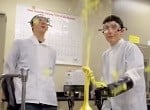
Are you a young researcher, technologist, inventor, builder or explorer? If you are, the Google Science Fair invites you to submit ideas “that might change the world around us” and compete for prizes.
The 5th annual Google Science Fair kicks off today and lasts until May 18th, 2015. The Fair is made possible thanks to Google, as well as LEGO Education, Virgin Galactic, Scientific American and National Geographic.
To be eligible, you must be aged between 13 and 18 years. You can submit your project online, across all scientific fields, from anthropology to computer science to biology and everything in between.
Ready to try? Are you aged 13 to 18? Click here to find out how to register.
Among the prizes are scholarships and classroom grants worth $100,000 from Google and Scientific American, an expedition to the Galápagos Islands sponsored by National Geographic.
There is also the chance to visit LEGO designers at their headquarters in Denmark, and an opportunity to tour Virgin Galactic’s new spaceship at its Majove Air and Spaceport.
There are some new awards this year, including one for an Inspiring Educator, and a Community Impact Award aimed at promising ideas for improving the environment or human health.
Education team member, Miriam Schneider, wrote in the Official Google Blog:
“It’s only through trying something that we can get somewhere. Flashlights required batteries, then Ann Makosinski tried the heat of her hand. His grandfather would wander out of bed at night, until Kenneth Shinozukatried a wearable sensor.”
“The power supply was constantly unstable in her Indian village, so Harine Ravichandrantried to build a different kind of regulator. Previous Science Fair winners have blown us away with their ideas. Now it’s your turn.”
Several companies are collaborating to sponsor the prizes of the Google Science Fair.
Promising ideas that can potentially make a big impact typically start from something small, something that makes us curious, something we love, we’re good at and want to try.
Google’s message to young scientists is “So, what will you try?”
