
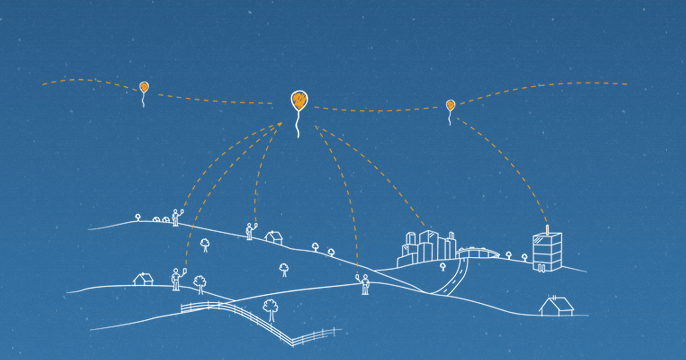
Google is determined to make internet access more widespread in underserved parts of the world by using high-altitude balloons to offer connectivity.
When the company first announced its ambitious plan, called Project Loon, many were skeptical about whether it was really possible.
However, the company has made some major milestones and its “floating cell towers in the sky” are now capable of staying up at heights of 20 kilometers for six months – delivering LTE signals to devices on the ground.
When Google first started testing its balloons it couldn’t keep them up for more than five days, since then its range has since quadrupled.
At the Mobile World Congress in Barcelona Sundar Pichai, a senior vice president at Google, said that the project is a significant engineering challenge.
“We think the model is really beginning to work,” he said.
For those unfamiliar with Project Loon, Google says:
“Project Loon balloons float in the stratosphere, twice as high as airplanes and the weather. In the stratosphere, there are many layers of wind, and each layer of wind varies in direction and speed. Loon balloons go where they’re needed by rising or descending into a layer of wind blowing in the desired direction of travel.”
“By partnering with Telecommunications companies to share cellular spectrum we’ve enabled people to connect to the balloon network directly from their phones and other LTE-enabled devices. The signal is then passed across the balloon network and back down to the global Internet on Earth.”
Could end up generating billions for the company
According to The Verge, Google envisions the project eventually becoming a business that could generate tens of billions of dollars.
Google would make money by partnering with telecom companies to beam their LTE services via the balloons to areas that the service providers don’t cover. Google would split the revenue from any new customers with the telecom company providing the LTE spectrum.
Project Loon lead Mike Cassidy told The Verge:
“Think about it — with 4.5 billion people without internet access, take 5 percent; you’re talking 250 million people,” he says. If those people pay just a small portion of their monthly income, say $5 a piece, “you’re going to be in a billion dollars a month in revenue, tens of billions a year in revenue. So it’s good business, too.”
Project Loon end up being a huge business for Google.
