
Graphene is able to convert light to electricity at ultra-fast speeds, which could have a major impact on several technologies, ranging from solar cells to cameras. It could also take data communication applications to their next level, since it allows for information carried by light to be converted into electrical data that can be processed in electrical circuits.
Scientists knew that graphene was a super material for ultra-fast conversion of light to electrical signals, but nobody was certain how fast it would respond to super-fast flashes of light.
An international team of scientists has now demonstrated that a graphene-based photodetector converts absorbed light into electrical voltage at super-high speed.
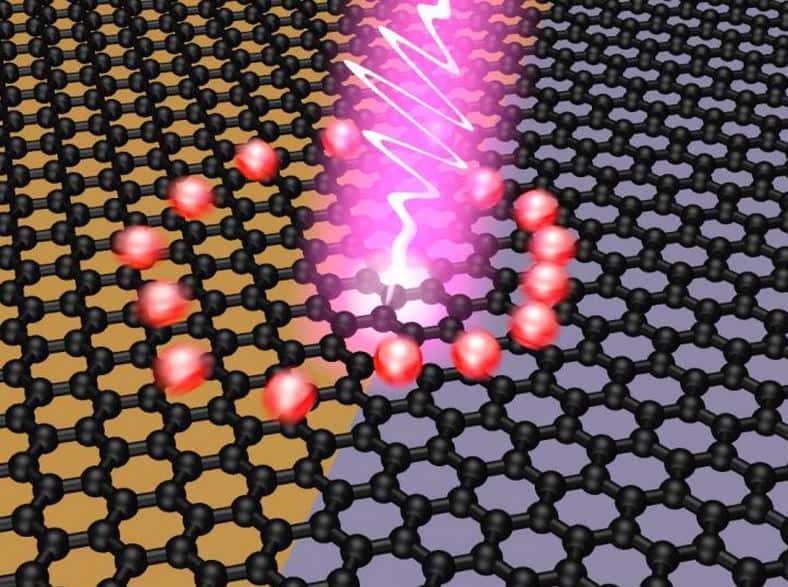
An illustration of ultrafast photovoltage creation after light absorption at the interface of two graphene areas with different Fermi energy. (Image: courtesy Achim Woessner)
Their findings were published in the academic journal Nature Nanotechnology (citation below).
Graphene is the strongest, thinnest, lightest and toughest material we know of. It is also very flexible and nearly transparent.
Light to electricity in under 50 femtoseconds
The researchers developed a new device that can convert light into electricity in less than 50 femtoseconds, i.e. a twentieth of a millionth of a millionth of a second.
To do this, they used a combination of ultra-fast pulse-shaped laser excitation and highly-sensitive electrical readout.
Co-author Dr. Klaas-Jan Tielrooij, who works at ICFO – The Institute of Photonic Sciences, Barcelona, Spain, said:
“The experiment uniquely combined the ultrafast pulse shaping expertise obtained from single molecule ultrafast photonics with the expertise in graphene electronics.”
“Facilitated by graphene’s nonlinear photo-thermoelectric response, these elements enabled the observation of femtosecond photodetection response times.”
The super-fast creation of a photovoltage in graphene is possible due to the ultra-fast and efficient interaction between all conduction band carriers in graphene.
This interaction results in a rapid creation of an electron distribution with an elevated electron temperature. Consequently, the energy absorbed from light is efficiently and rapidly converted into electron heat.
The electron heat is then converted into a voltage at the interface of two graphene regions with different doping.
This photo-thermoelectric effect appears to occur nearly instantaneously, thus enabling the ultra-fast conversion of absorbed light into electrical signals.
Co-author, Professor Niek van Hulst, also from ICFO, said:
“It is amazing how graphene allows direct non-linear detecting of ultrafast femtosecond (fs) pulses.”
The study findings open a new pathway towards ultra-fast optoelectronic conversion.
Co-author Professor Frank Koppens, from ICFO, said:
“Graphene photodetectors keep showing fascinating performances addressing a wide range of applications.”
The study was funded by the European Commission’s Graphene Flagship, an NWO Rubicon fellowship, an ICFO-Cofund fellowship, the MIT MISTI-Spain program, and the Fundacio Cellex Barcelona.
Citation: “Generation of photovoltage in graphene on a femtosecond timescale through efficient carrier heating, Nature Nanotechnology,” K. J. Tielrooij, L. Piatkowski, M. Massicotte, A. Woessner, Q. Ma, Y. Lee, K.S. Myhro, C.N. Lau, P. Jarillo Herrero, N. van Hulst and F. H. L. Koppens. Nature Nanotechnology. Published 13 April, 2015. DOI: 10.1038/nnano.2015.54.
