
Greater market liquidity means more risk market risk, say researchers from Ben-Gurion University (BGU) in Beersheba, Israel. Their findings challenge most common theories regarding market liquidity.
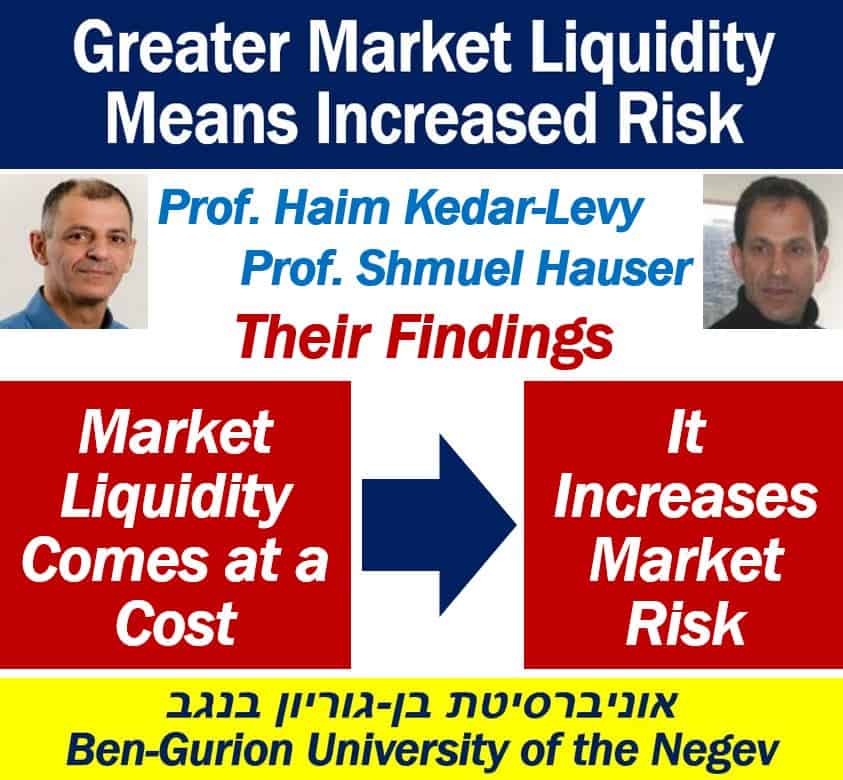
Most theories state that greater liquidity is better for financial markets. However, Prof. Haim Kedar-Levy and Prof. Shmuel Hauser found that liquidity comes at a cost. That cost is greater market risk.
Prof. Kedar Levy works at the BGU Department of Management. Prof. Hauser works at the Department of Business Administration in the Guilford Glazer Faculty of Business, which is part of BGU.
The professors will present their theory at the 25th Annual Conference of the Multinational Finance Society, which this year is held in Budapest, Hungary.
The wrote about their study and findings in the Journal of Financial Markets (citation below).
But, isn’t market liquidity vital?
Most financial literature tells us that market liquidity of specific assets is a vital and positive attribute. They say that it can add value to, for example, stocks, and also reduce risk.
Professors Hauser and Kedar Levy agree. However, their findings on what impact market liquidity has on the whole market are different.
Market liquidity scenario
Professors Hauser and Kedar-Levy wrote:
“The model we developed is richer than the classic theory because, among other reasons, it takes into account a more realistic treatment of financial markets in which various investors have different investment strategies.”
“Investors differ in the amount of risk they are willing to assume, and therefore choose different proportions of investments in risky assets, such as equities.”
Volatility in appetite for risk
In their scenario, which the Professors describe as more realistic, greater market liquidity results in more volatility. Specifically, greater volatility in the average appetite for risk in the overall market.
At reasonable risk, trading volume, appetite parameters, and stock market liquidity as a whole peak.
Sharpe ratio
When they peak, there is a huge exchange of stocks between investors with different risk tolerances. This attribute subsequently makes the market price of risk become highly volatile. This also makes all stocks riskier.
In this context, the word ‘stocks‘ means the same as ‘shares.’ Hence the term ‘stocks and shares.’
We also refer to the market price of risk as the ‘Sharpe ratio.’ The Sharpe ratio is a way of measuring the real return on an investment, after adjusting for risk. It is a useful measure when investors seek to compare, for example, two investment options. It is useful because it factors out volatility.
An investor needs to be compensated for the extra risk versus holding, for example, cash, which is a risk-free asset.
What happens if, for example, investors in the market have very similar or very different risk tolerances? Then, liquidity and trading volume decline, and subsequently market risk declines too.
Market liquidity comes at a cost
The researchers added:
“This is not to say that we favor less liquid markets over highly liquid ones, but we find that liquidity comes at cost. It is not a free attribute of stock markets.”
Citation:
“Liquidity might come at cost: The role of heterogeneous preferences,” Shmuel Hauser and Haim Kedar-Levy. Journal of Financial Markets. Volume 39, June 2018, Pages 1-23. https://doi.org/10.1016/j.finmar.2018.03.001.
