
Housing starts in Canada in November, at 195,792, were virtually the same as October’s 195,796, Canada Mortgage and Housing Corporation (CMHC) reported on Monday. CMHC says the figures are six-month moving averages of the monthly seasonally-adjusted annual rates (SAAR) of housing starts.
Bob Dugan, CMHC’s Chief Economist, said:
“The trend essentially held steady for a third consecutive month in November. This is in line with our expectations for 2014, of a stable national picture with new home building concentrated in multiple starts, particularly in Quebec, British Columbia and Ontario.”
CMHC utilizes the trend measure to complement its monthly SAAR of housing starts to account for significant fluctuations in monthly estimates and get a more complete picture of the state of the country’s housing market. Sometimes analyzing just SAAR data can be misleading.
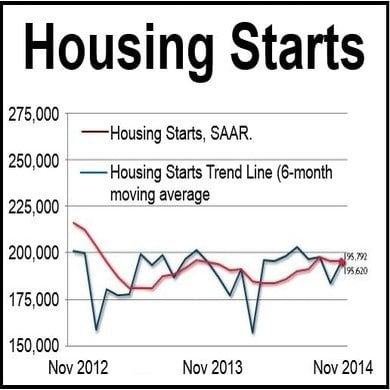
Source: “Housing Starts in Canada – All Areas,” CMHC.
November’s standalone monthly figure was 195,620, compared to 183,659 in October. The SAAR of urban starts rose in November to 176,343 versus 164,784 in October. Most of the increase was in multiple urban starts, which in November reached 112,583, while single-detached urban dwelling starts fell to 63,760 units.
British Columbia posted the steepest rise in urban housing starts in November, followed by Quebec, Ontario and Atlantic Canada. In the Prairies urban housing starts declined.
Rural starts were estimated at an SAAR of 19,277 units.
Building Permits October 2014
In another report, Statistics Canada informed that the total value of building permits in October was $7.5 billion, a 0.7% increase on September. Most of the rise came from higher construction intentions in British Columbia, Saskatchewan, and Alberta.
The value of non-residential building permits grew by 2.4% in October versus September to $3.1 billion. Gains were seen in British Columbia, Quebec (distant second), and Yukon. Ontario posted the largest decline after rising considerably in September.
The value of residential building permits fell 0.4% to $4.5 billion in October, after rising by 7.4% in September. Residential construction intentions declined in five provinces, with Ontario and Quebec posting the steepest falls. Nova Scotia and Alberta posted sizable increases.
