
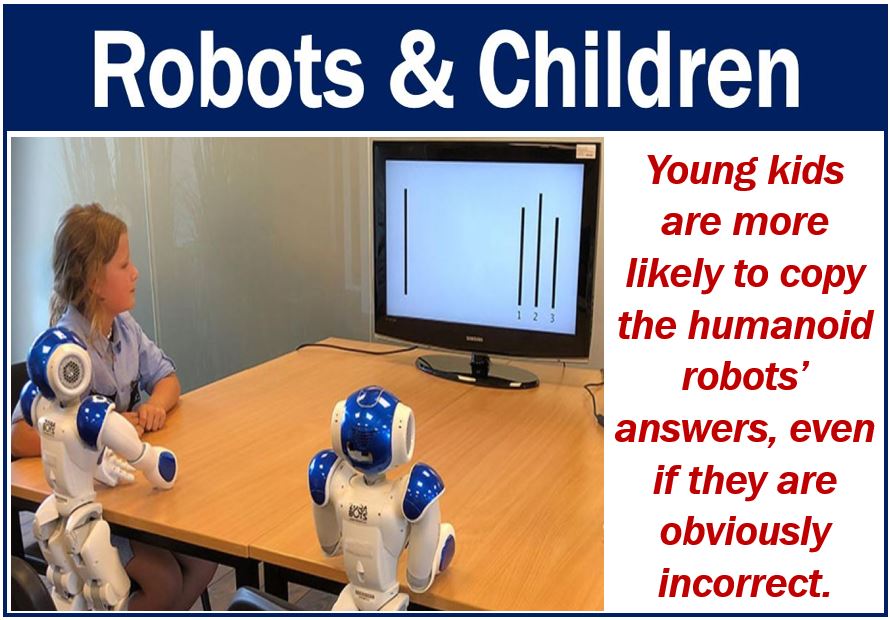
Humanoid robots can influence children’s opinions significantly, researchers at the University of Plymouth in England have found. Young children are more likely to respond with a robot’s answer even if it is clearly the wrong answer.
In the study, Anna Vollmer and colleagues compared how children and adults responded to identical tasks. Researchers observed them in the presence of both humanoid robots and their peers.
Study co-leader, Vollmer, was a researcher at Plymouth University. Today, she is a Postdoctoral Researcher at the University of Bielefeld in Germany. The other co-leader, Tony Belpaeme, is a Professor in Robotics at Ghent University in Belgium and the University of Plymouth.
The researchers wrote about their study and findings in the academic journal Science Robotics (citation below).
Adults, children, and humanoid robots
Adults
The study showed that adults’ peers regularly influence their opinions. Previous studies had also demonstrated this.
However, adults are mostly able to resist the influence of humanoid robots.
Children
Children, aged seven to nine, on the other hand, were more likely to copy the responses made by the humanoid robots. This happened even if the robots’ answers were obviously incorrect.
The Asch paradigm
The researchers used the Asch paradigm in their study. Solomon Eliot Asch (1907-1996), a Polish gestalt psychologist and social psychology pioneer, developed the Asch paradigm in the 1950s.
The paradigm asks participants to look at a screen which has four lines. They must say which two lines have the same length.
People rarely make a mistake when they are on their own. However, we tend to follow what others are saying when we are not alone.
Children alone and with humanoid robots
When the children were alone in the room, they scored 87% on the test.
When the humanoid robots joined them, however, their score dropped to 75%. Seventy-four percent of the children’s wrong answers were the same the robots’.
This study provides an interesting insight, the authors wrote, into how robots might be used positively within society. However, robots, especially humanoid robots, also have the potential to influence vulnerable young children negatively.

Children have a strong affinity with robots
Whether people would conform to humanoid robots, Professor Belpaeme said:
“People often follow the opinions of others and we’ve known for a long time that it is hard to resist taking over views and opinions of people around us. We know this as conformity. But as robots will soon be found in the home and the workplace, we were wondering if people would conform to robots.”
“What our results show is that adults do not conform to what the robots are saying. But when we did the experiment with children, they did. It shows children can perhaps have more of an affinity with robots than adults, which does pose the question: what if robots were to suggest, for example, what products to buy or what to think?”
Robots’ impact in different settings
Plymouth researchers have worked extensively to explore the potential positive impacts of robots. They have investigated robots’ impact in, for example, education and health settings.
Researchers at Plymouth led a four-year ALIZ-E program which demonstrated that social robots can help children with diabetes. The robots can help the children come to terms with the nature of their condition.
The investigators are currently leading L2TOR, which plans to design a robot that teachers can use. If all goes according to plan, the robot will support preschool children in learning a second language.
Regarding their study, the authors concluded:
“A future in which autonomous social robots are used as aids for education professionals or child therapists is not distant. In these applications, the robot is in a position in which the information provided can significantly affect the individuals they interact with.”
“A discussion is required about whether protective measures, such as a regulatory framework, should be in place that minimizes the risk to children during social child-robot interaction and what form they might take so as not to adversely affect the promising development of the field.”
What are humanoid robots?
Humanoid robots are robots whose body shapes are built to resemble the human body.
Engineers may have designed them to look like humans for functional purposes. Sometimes they design them this way to study how we move.
In most cases, humanoid robots have a head, two legs, two arms, and a torso. Some have human facial features such as eyes and a mouth.
The majority of robots, however, especially those we use in, for example, factories, are not humanoid.
Some robots have artificial intelligence or AI. AI refers to software technologies that make devices, such as robots, think and behave like humans. AI is becoming more common in production and business processes, as well as in people’s homes.
Citation
“Children conform, adults resist: A robot group induced peer pressure on normative social conformity,” Anna-Lisa Vollmer, Robin Read, Dries Trippas, and Tony Belpaeme. Science Robotics, 15 Aug 2018: Vol. 3, Issue 21, eaat7111. DOI: 10.1126/scirobotics.aat7111.
