

IATA, which represents over 200 airlines, lowers its global airline profits forecast to $18 billion for 2014. The International Air Transport Association (IATA) said its profit projection was pared by $700 million because of higher fuel costs and slower growth in China and other emerging markets.
IATA’s 2014 profits forecast represents a 70% gain on 2013’s $10.6 billion.
At the group’s annual meeting in Doha, Qatar, IATA’s CEO Tony Tyler predicts sales of $746 billion for 2014, about $1 billion more than had been forecast in March.
Everyday a struggle
Mr Tyler said:
“As a global industry, our financial performance does not yet match the value that we deliver. Some airlines will do better. But even if you’re smart or lucky enough to be one of those, every day is still a struggle to keep revenues ahead of costs.”
According to Tyler, the following are expected to weigh heavily on airlines this year:
- high taxes,
- expensive regulation,
- infrastructure costs,
- inefficiencies in air traffic management,
- slower growth in emerging markets, and
- high fuel costs.
Very low net margins
The airline industry today earns an average net margin of only 2.4%, the equivalent of about $6 per passenger.
Average return on investment capital, however, has increased from 1.4% in 2008 to 5.4% today. Mr. Tyler pointed out, though, that the industry is still a long way from earning the 7% to 8% cost of capital return that investors would expect.
According to IATA, air passengers today have much better deals that in the past:
- Consumer choice is much greater today. Since 1994, the number of city pairs has doubled.
- Flying relative to other prices today is a greater bargain now. We can now circle the globe “for about the cost of four iPads.”
- Airlines are upgrading their products throughout the world. In the US, for example, nearly $1 billion is being invested each month on product upgrades.
North American outlook good
North America is forecast to register net income of $9.2 billion, which is more than half the global total. This is equivalent to retained a profit of $11.09 per passenger, much higher than $2.83 in 2012.
Other regions, such as China and other some emerging markets where business confidence has slipped, will do less well, IATA believes.
IATA says that this year the airline industry will:
- connect 3.3 billion passengers,
- cover more than 50,000 routes,
- transport 52 million tonnes of cargo,
- carry out 100,000 flights each day,
- employ more than 58 million workers, and
- generate $2.4 trillion in economic activity.
Malaysia Airlines Flight 370
Regarding the disappearance of Malaysia Airlines Flight 370, with no trace of the Boeing 777, Mr. Tyler said:
“The loss of MH370 points us to an immediate need. A large commercial airliner going missing without a trace for so long is unprecedented in modern aviation.”
“And it must not happen again. IATA, ICAO (17) and experts from around the world are working together to agree on the best options to improve global tracking capabilities. In September, a draft of recommendations will be given to ICAO.”
April demand showed healthy increase
Global passenger traffic (total revenue passenger kilometers) increased by 7.5% in April 2014 compared to April 2013, an improvement of 2.9% compared to the previous month.
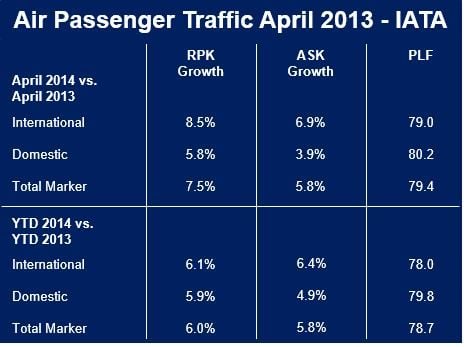
Airlines in all regions recorded growth.
IATA added that the figure was somewhat biased due to the timing of the Easter holiday, which this year occurred in April, a month later than in 2013.
Mr. Tyler said:
“April’s demand growth was a pleasant surprise in the face of the moderating trend of recent months but it is not clear whether the acceleration in demand is sustainable in view of global economic trends including slower growth in China.”
