
Leaders who are stuck in the past often create ineffective cultures, a new study shows. What is the origin of culture? This basic question is a difficult one for both practitioners and researchers to answer. It is a tough question because we take culture for granted. It is also deeply entrenched in our minds.
Most researchers, to date, have proposed a functional view to culture. In other words, they believe that culture is a response to current needs. Specifically, needs within and outside a group. Therefore, the culture that ensues enables the group to perform optimally.
Researchers from the University of Toronto, however, show that culture has another cause – a leader’s past experience.
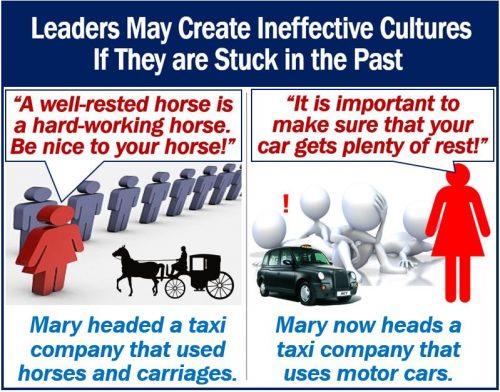
Cultures from past experience may be ineffective cultures
Whatever culture a leader experienced in the past is likely to shape the culture of the group they subsequently lead.
CEOs, for example, who learned A, B, and C in their last company, might push A, B, and C within their current organization. They might do this even though D, E, and F are more relevant to today’s circumstances.
CEO stands for chief executive officer. The CEO is the most senior person in a company. He or she is in charge of managing a non-profit or for-profit organization.
The culture they create may turn out to have very little to do with group performance. It is irrelevant to the group’s performance because the past experience has driven that culture.
Yeun Joon Kim and Soo Min Toh wrote about their study and findings in the journal Academy of Management Journal (citation below). Kim is a doctoral candidate at the Rotman School of Management at the University of Toronto. Toh is an Associate Professor of Organizational Behavior at the University of Toronto Mississauga (UTM). Toh also works at the Rotman School and is Director of the Institute of Management and Innovation at UTM.
Kim and Prof. Toh studied groups created in a behavioral lab. They also studied sales groups that had formed recently at a manufacturing start-up. In all the groups, each leader was new.
Leaders may create ineffective cultures in new groups
The new leaders created their groups’ cultures according to their past cultural experience. Specifically, what they experienced in their former groups.
The authors referred to this finding as cultural transfer perspective. In other words, the new leaders tended to transfer the same cultures they acquired in previous groups to their current groups.
There is nothing to stop the new leaders creating ineffective cultures for their new groups. In other words, the cultures they created in their new groups may have been ineffective at improving group performance.
Ideally, leaders should analyze their groups’ current circumstances when creating their cultures. However, most leaders are too busy to do that. They, therefore, fall back on old, familiar approaches, said Kim.
Citation
“Stuck in the Past? The Influence of a Leader’s Past Cultural Experience on Group Culture and Positive and Negative Group Deviance,” Yeun Joon Kim and Soo Min Toh. Academy of Management Journal (2018). DOI: https://doi.org/10.5465/amj.2016.1322.
